On 3 August the Korean government published its 2026 tax revision bill. The ISA — the tax-advantaged brokerage wrapper most Korean savers use — gets split in two.
A new “Productive-Finance ISA” pays no tax at all on interest and dividends. The catch is that it may only hold Korean equities. The existing regular ISA, meanwhile, loses two features.
The backlash was immediate. President Lee Jae-myung ordered a full review, and six competing bills are already before the National Assembly. Nothing is settled until December.
The new account taxes dividends at zero
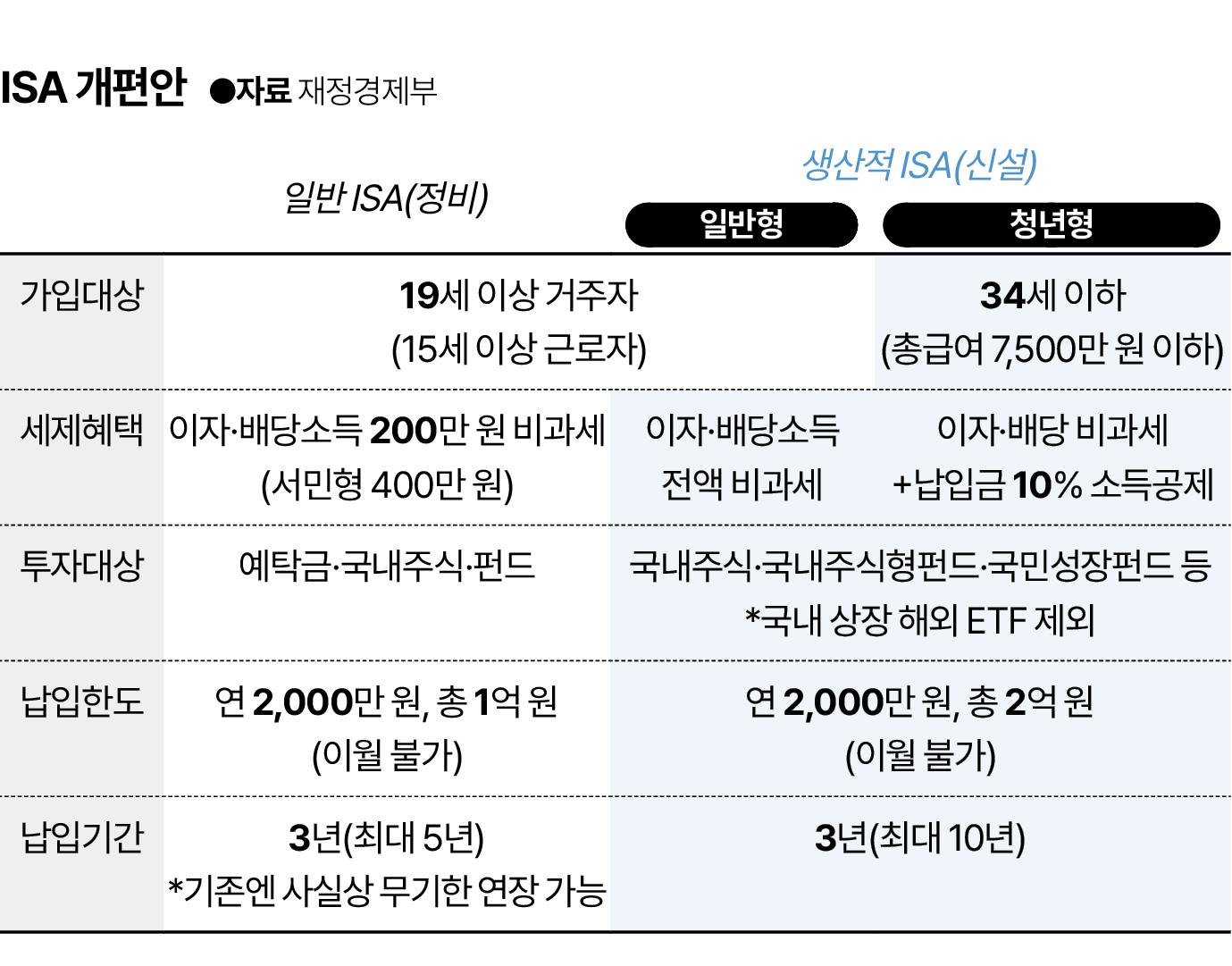
That is the whole pitch. There is no exemption ceiling on interest and dividend income. The regular ISA exempts only the first 2 million won (4 million for lower-income savers) and taxes the rest at 9.9%.
Contributions are capped at 20 million won a year and 200 million won in total. The lock-in is three years and the account can run for ten. One per person, and you may hold it alongside a regular ISA.
It applies to accounts opened from 1 January 2027, and you must sign up by the end of 2029. Withdraw more than your principal within three years, or close early, and the exemption is clawed back.
Savers aged 15 to 34 earning under 75 million won gross also get an income deduction worth 10% of contributions, up to 850,000 won.
But it can only hold Korean stocks
Eligible assets are Korean listed shares, Korean equity funds, the state-backed National Growth Fund and business development companies. That is the whole list.
No deposits. No foreign ETFs, even the ones listed in Seoul. No overseas funds. Whatever asset mix you run in your current ISA, you cannot port it across.
The reasoning is on the record. Foreign ETFs had grown past 25% of assets held in existing ISAs, and the government decided its tax break was funding capital flight.
Critics in the industry say the design removes the last defensive layer. Requiring a minimum share in Korean equities would have been one thing; banning everything else is another.
The KOSPI yields 0.92%
Here is the problem with a dividend-tax exemption in Korea right now. There are barely any dividends to exempt.
The KOSPI dividend yield was 0.92% on 4 June, down from 2.14% a year earlier. On 29 April it touched 0.82%, the lowest since March 2000.
Payouts did not shrink. Share prices rose. The Korean market has run hard, and the yield collapsed underneath it.
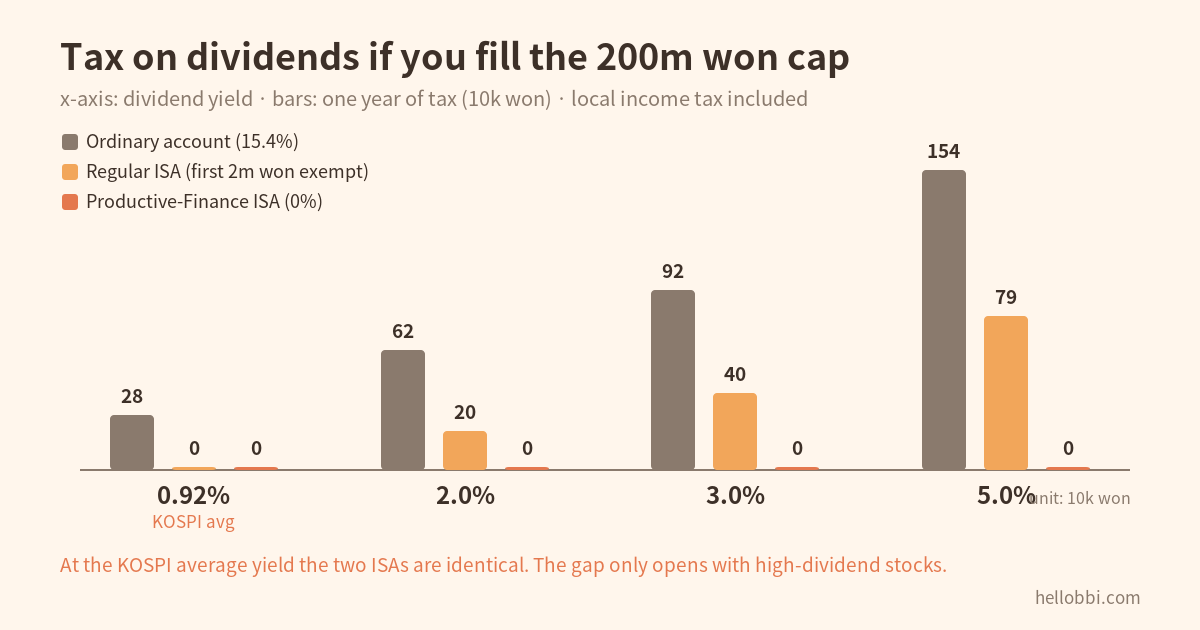
So the arithmetic goes like this. Fill the 200 million won cap over ten years, hold the index, and you collect 1.84 million won a year in dividends. That fits inside the regular ISA exemption. Both accounts owe zero.
The gap only opens if you concentrate in high-dividend Korean names yielding 3% to 5%. At 3% the new account saves about 400,000 won a year over a regular ISA; at 5%, about 790,000 won.
Which means this is an account built for someone putting 200 million won into Korean dividend stocks. With deposits and foreign assets off the table, there is no way to hedge that concentration inside the wrapper.
The regular ISA loses two things
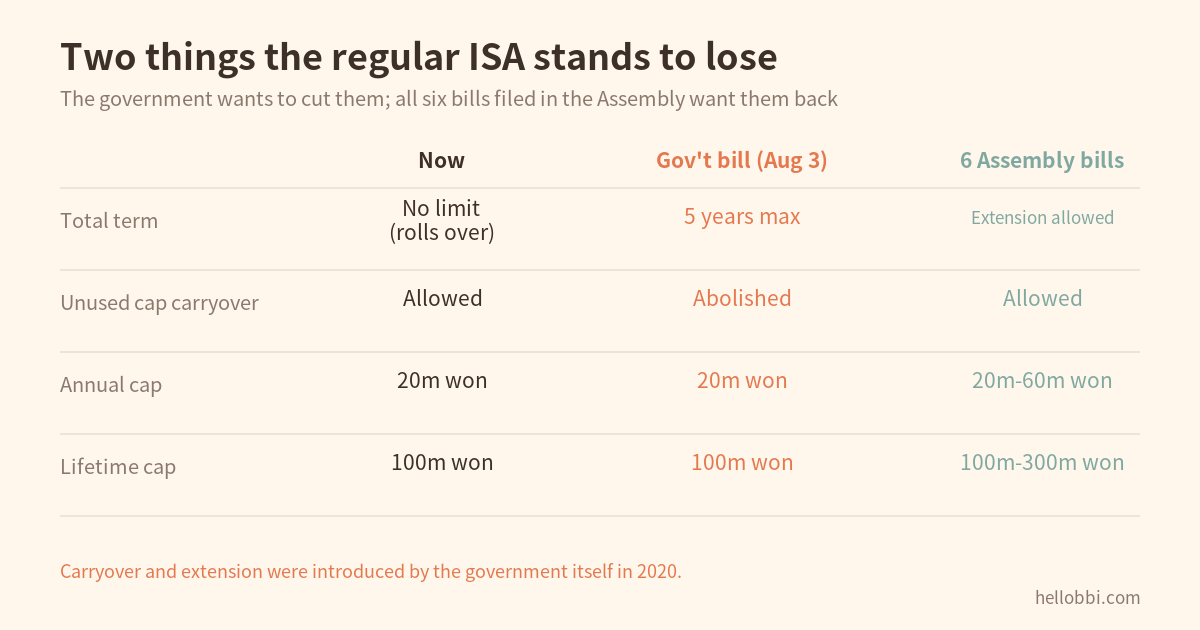
First, the total term is capped at five years. Today you clear a three-year minimum and then roll it over indefinitely.
Second, unused annual allowance can no longer be carried forward. Miss part of this year’s 20 million won and it is gone.
The 20 million won annual and 100 million won lifetime caps stay. So do the exemption ceiling and the eligibility rules.
The losers are identifiable. Self-employed people and freelancers with lumpy income, and younger savers whose earnings are still climbing. Both rely on catching up in a good year.
There is an awkward footnote. Carryover and term extension were created by a Korean government in 2020, with this rationale:
So that investors can contribute flexibly as their circumstances allow. Without the ability to extend, investors would be forced to sell their holdings regardless of market conditions.
Government explanation during the 2020 tax bill debate, as reported by Hankook Ilbo
The president ordered a rethink
Criticism came from inside the governing party too, and President Lee called for a full review. A redesign now looks unavoidable.
Six amendment bills are already filed — four from the Democratic Party, two from the People Power Party. All six restore both the carryover and the term extension, the exact opposite of the government bill.
They differ on the caps, ranging from 20 to 60 million won a year and 100 to 300 million won lifetime.
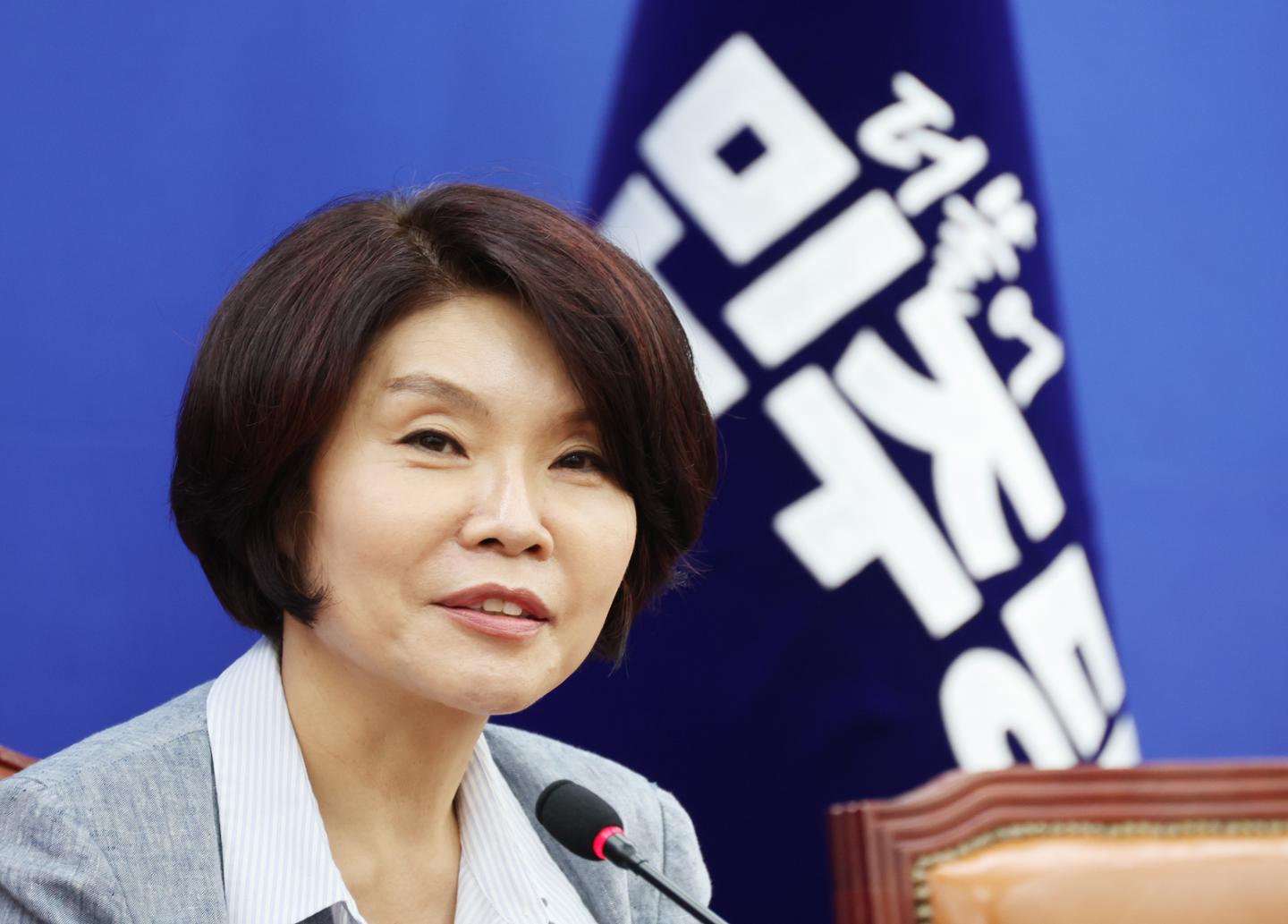
There is no need to touch the existing ISA. The Productive-Finance ISA coming in on top of it can simply be optional.
Han Jeoung-ae, Democratic Party policy chief, 9 August 2026
The likely landing point is that current benefits survive and the new account becomes a choice rather than a replacement. That is not a settled position yet.
What to do about it now
Public comment on the bill closes on 20 August, through the government’s legislative participation portal. After that: cabinet on 1 September, submission to the Assembly by 3 September, final passage in early December.
If you are a foreign resident in Korea, two things matter. Residency, not nationality, determines eligibility — 19 and over, or 15 and over if employed. And anyone assessed for comprehensive financial income tax in any of the previous three tax years is excluded outright.
That exclusion is worth sitting with. The more dividend income you earn, the more this account is worth to you, right up until the point where it disqualifies you from opening one.
Nothing needs doing in 2026. The new account starts with 2027 sign-ups and the terms may still move. If you hold a regular ISA, just check whether you have carried-forward allowance sitting unused.
We will revisit this once the Assembly votes.
This is a summary of a published proposal, not tax advice. Outcomes vary with individual circumstances — confirm with a tax professional. Nothing here recommends a specific product or security.
Sources
- Ministry of Economy and Finance — 2026 Tax Revision Bill (announced 3 Aug 2026)
- Bae, Kim & Lee LLC — 2026 Tax Revision Bill I (side-by-side ISA table)
- Herald Business (Korean) — New Productive-Finance ISA, regular ISA capped at five years
- Hankook Ilbo (Korean) — Backlash over the ISA overhaul; ruling party says the existing ISA stays
- Kookmin Ilbo (Korean) — A ‘buy-Korea-only’ ISA that trims the existing one
- Financial News (Korean) — KOSPI market cap tripled, dividend yield halved
Leave a Reply