The short version: the ball in your bag stays legal until January 2030. Retail balls, club-round balls, screen-golf balls — none of them change.
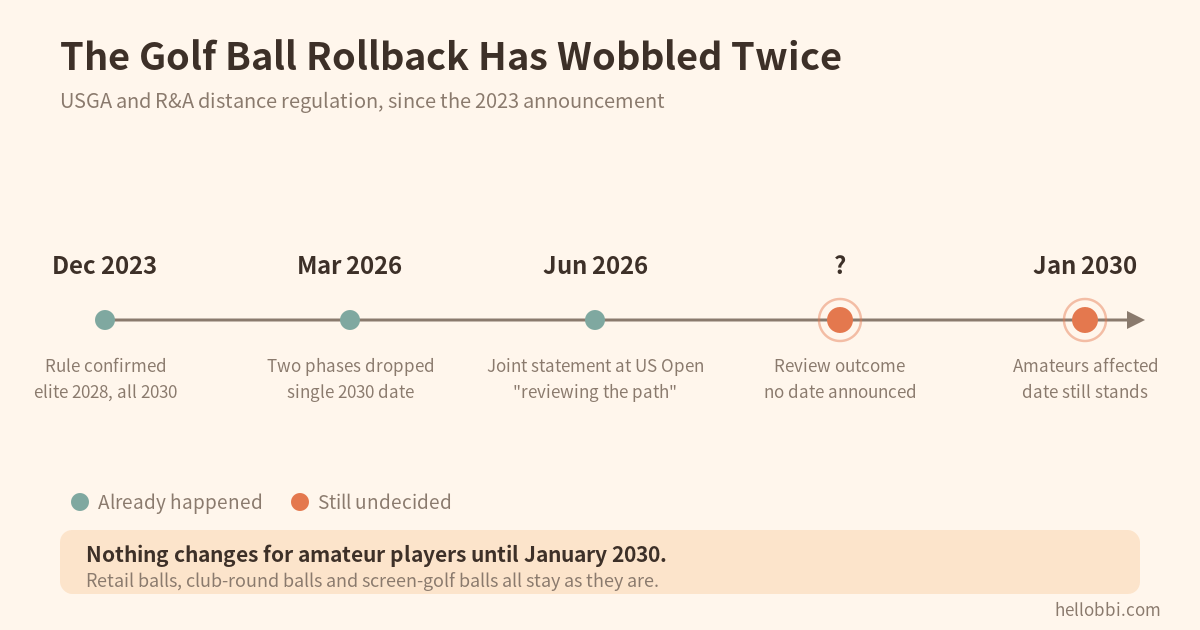
This is about the golf ball distance rollback. The schedule confirmed in December 2023 has wobbled twice this year.
Once in March, once in June. It has now sat unresolved for over two months.
The governing bodies blinked in the middle of the US Open
The original plan had two phases. Elite play from 2028, everyone else from 2030.
March killed the two-phase approach and merged it into a single 2030 date. The reason was retail: a shop would have had to sell a ball that was legal for one customer and illegal for another.
June 17 brought something bigger. During the US Open, the USGA, the R&A, the PGA Tour and the DP World Tour issued a joint statement saying they would revisit the path.
It is not a withdrawal. The 2030 date is still standing. But the conversation widened from the ball alone to clubs and course setup.
One moment pushed this along. Cameron Young hit 375 yards on his last tee shot at the Players Championship while playing a prototype ball built to the new spec.
That raised the obvious question of whether changing the ball solves anything.
Amateurs gained one tenth of a yard in eight years
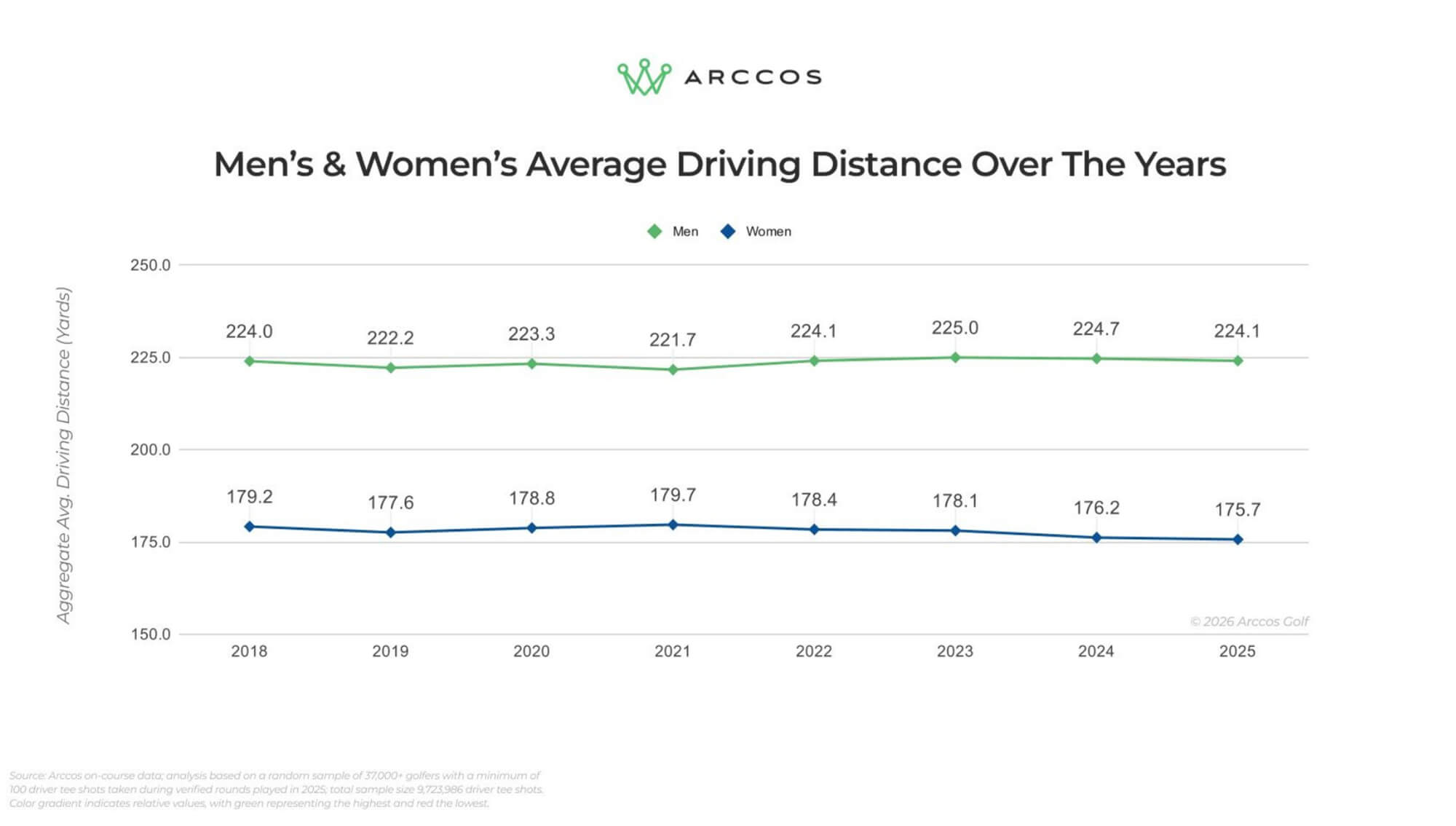
Arccos published its 2026 distance report in May. It draws on more than five million rounds and roughly ten million drives from 2025.
The average male amateur drive was 224.0 yards in 2018. In 2025 it was 224.1.
That is 0.1 yards in eight years. Women went the other way, from 179.2 to 175.7.
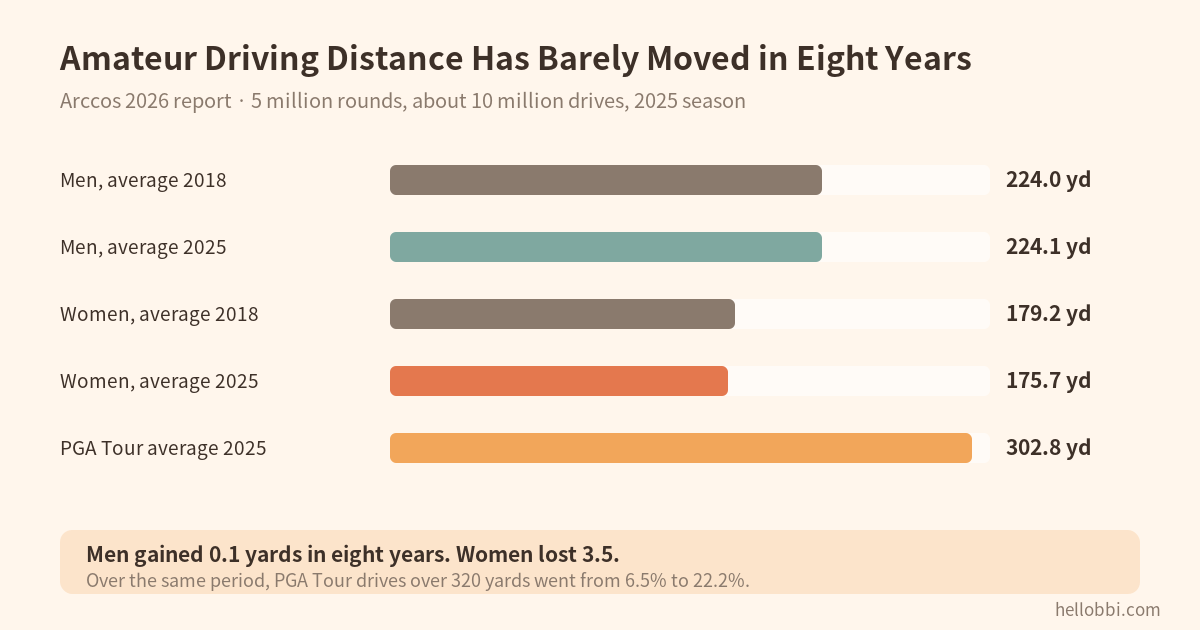
The professional game moved. Drives over 320 yards made up 6.5% of measured tee shots on the PGA Tour in 2016. This year they are 22.2%.
If there is a distance problem, this is where it lives.
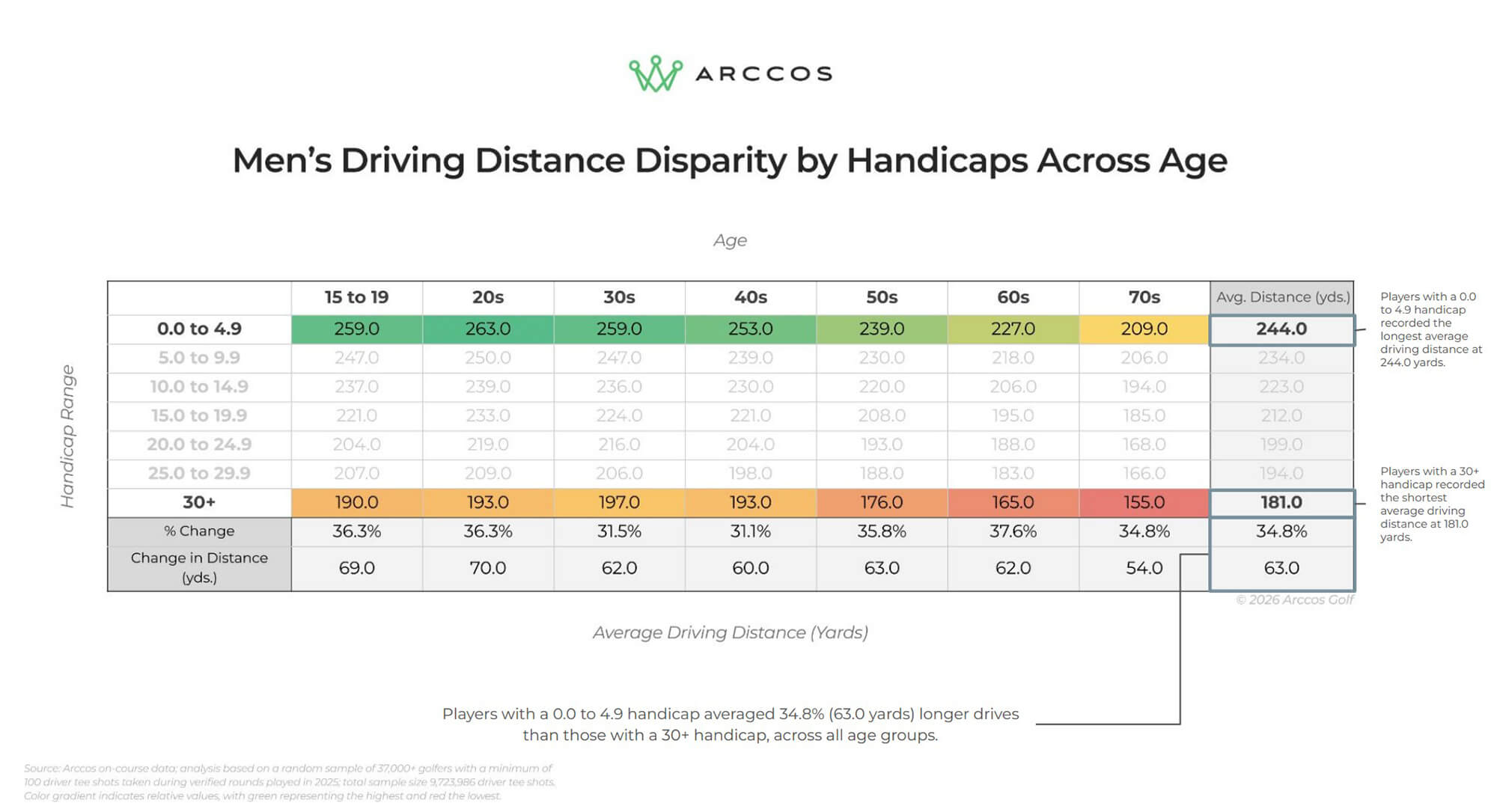
The spread by handicap is wide. Scratch to 4.9 averages 244 yards. Handicap 30 and above averages 181. That is a 63-yard gap.
The more useful number is penalties. The low-handicap group takes a penalty or a forced recovery on 12% of drives. The 30-plus group does it on 45%.
If you shoot in the 80s or 90s, that is where your strokes are.
The data has its critics, and fairly so. How a system counts mishits will skew any average.
And unless players used a 2018 driver in 2018 and a 2025 driver in 2025, the comparison does not hold. I think that objection lands.
What actually catches players right now is local rules, not the ball
Park Hyun-kyung was disqualified in June at the Mercedes-Benz Korea Women’s Open at Lakewood Country Club near Seoul.
She used a distance-measuring device on the first three holes. On the KLPGA Tour that device is allowed.
This event was run by the Korea Golf Association, which had adopted the model local rule banning them. Same device, different answer depending on who runs the tournament.
Club players face the same thing. In a club championship, the committee’s choice of local rules decides what is legal.
Six new or revised model local rules took effect on January 1 this year. Last year’s rules are not a safe guide to this year’s.

One thing worth knowing, straight from the R&A: the next edition of the Rules of Golf arrives on January 1, 2028. There is no 2027 revision.
The money moved faster than the equipment rules
Korea splits its courses into a subsidised public tier and a membership tier. The public tier has a reference green fee: 199,000 won on weekdays, 259,000 won at weekends.
Forty-four courses exceed it on weekdays and forty-two at weekends — about 17% of the 258 public courses with 18 holes or more.
The rule tests average green fees, not peak ones. That is the gap.
Caddie fees rose faster than anything else. The public-course team average went from 81,800 won in 2006 to 146,300 won in February this year, up 78.9%.
Green fees over the same twenty years rose 67.2% on weekdays and 53.1% at weekends.
A couple playing as a two-ball feels this most. The caddie fee is charged per team, so two players pay 75,000 won each where four would pay 37,500.
Card payment for caddie fees is being negotiated. Lawmakers met the culture ministry on August 10 to discuss it.
Uptake is reportedly under 1%. One course on Jeju adds 4.4% — about 6,600 won — to a 150,000 won caddie fee paid by card.
What to do about all this
Nothing about your ball. Keep playing what you play until 2030.
Do check the local rules for any tournament you enter, especially on rangefinders.
And if you have money and practice time to spend, the Arccos numbers suggest cutting penalties beats chasing yards.
The open question is when the review concludes. No date has been announced. Whether the PGA Tour writes its own equipment rules is still only a survey question.
We will write again when there is an answer.
Sources
- New and Updated Model Local Rules for 2026 — R&A 공식
- 2026년 골프 규칙 설명 업데이트 — 대한골프협회 공식
- US Open 2026: governing bodies statement on the rollback — Golf Digest
- 6 Insights From the 2026 Arccos Driving Distance Report — MyGolfSpy
- Arccos Driving Distance Report 2026 (PDF 원본)
- 박현경 거리측정기 사용 실격 — 서울경제
- 레저백서 2026, 대중형 골프장 그린피 — 서울경제
- 대중형 골프장 캐디피 20년간 78.9% 상승 — 녹색경제신문
Leave a Reply