A Lancet paper published in January puts the number at five minutes a day.
Among the least active people, adding five minutes of moderate-to-vigorous activity daily would head off roughly 6% of deaths in that group. Applied across the whole population it comes to about 10%.
This is aimed at people who play sport at weekends and sit still on weekdays. That describes us exactly.
One thing up front: every study below is observational. These are associations, not causes. More on that at the end.
The dose keeps getting smaller
The old advice was that offsetting a day of sitting took about an hour of movement. That figure came from questionnaires.
In 2020 researchers measured it with devices instead, strapping accelerometers to 44,370 people across four countries.
The answer came back at 30 to 40 minutes a day. Close to half the old number.
Which also tells you people overstate how much they move.
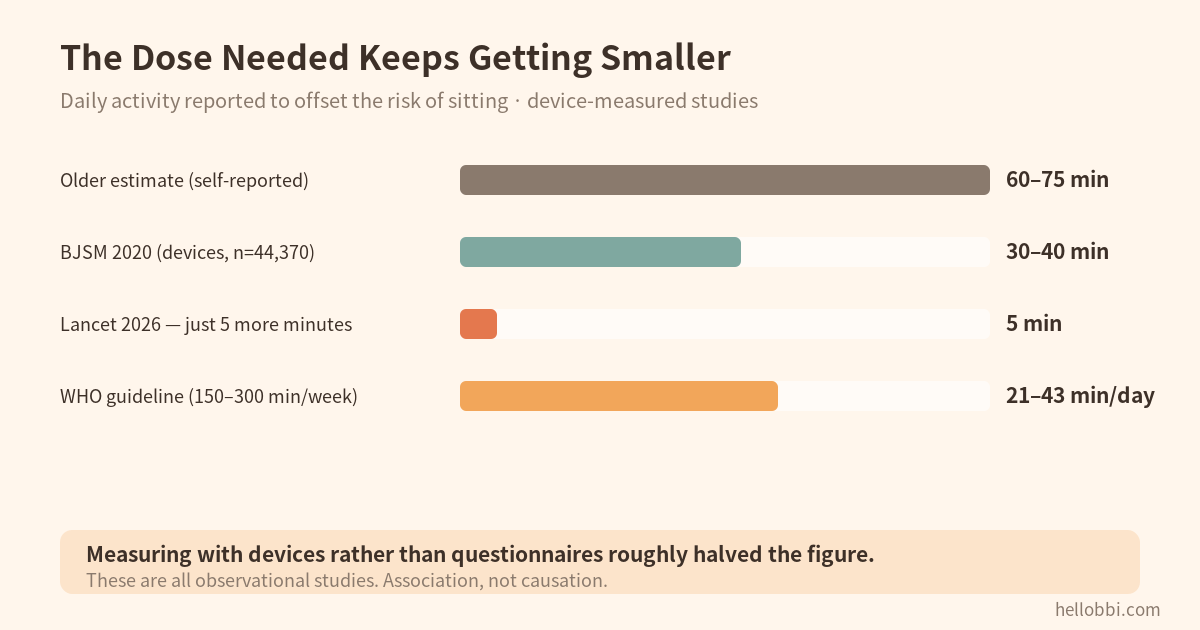
This year’s Lancet paper goes further, pooling data from up to 135,046 people in Norway, Sweden, the United States and the United Kingdom.
Five minutes. Cutting sitting by 30 minutes a day accounted for roughly 3% on its own.
The number shrank because the measurement got better, not because the bar was lowered.

The WHO guidance itself changed in 2020. The old requirement that activity come in bouts of at least ten minutes was dropped.
Short pieces count now.
The standing desk did not do what people hoped
This came out in December 2024. Researchers tracked 83,013 UK Biobank participants with wearable devices for about seven years.
Sitting behaved as expected. Past ten hours a day, each additional hour raised the risk of major cardiovascular disease by 15%.
Standing was the surprise. It did not lower cardiovascular risk at all. No change.
Something else went up instead. Past two hours of standing a day, each extra 30 minutes raised orthostatic circulatory disease risk by 11%.
That category covers low blood pressure on standing, varicose veins and chronic venous insufficiency.
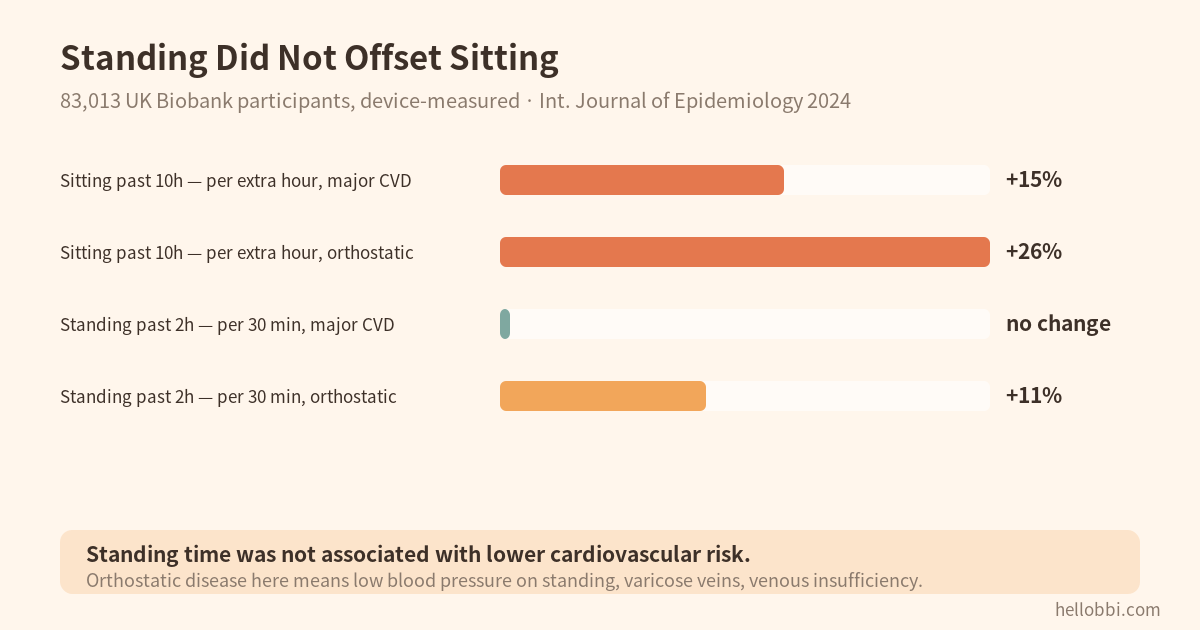
The paper’s own conclusion is that prescribing more standing time may not lower major cardiovascular risk and may raise orthostatic risk.
Raising the desk and moving are not the same intervention. The opposite of sitting turns out to be moving, not standing.
Micro-breaks lifted mood, not output
Another half-broken piece of conventional wisdom.
A 2022 meta-analysis pooled 22 samples and 2,335 people, looking at breaks of ten minutes or less.
Vigour improved, effect size 0.36. Fatigue fell, 0.35.
Task performance showed no statistically significant change: 0.16, with p at 0.116.
Breaks make you feel better. The evidence that they make you work better is thin. Meta-regression found longer breaks helped performance more, which hints that ten minutes may simply be too short.
Korean adults sit for nine hours a day
This comes from the national health and nutrition survey. Adult sitting time went from 8.3 hours in 2018 to 9.0 hours in 2023.
Over the same stretch, the share of adults meeting aerobic activity guidance barely moved: 52.5% in 2023, 52.1% in 2024.
Meanwhile obesity among men in their forties reached 61.7% in 2024, up 11.5 percentage points in a single year.
Teenagers sit longer still, past eleven hours a day. Sitting outside of study alone rose from 2.6 hours in 2017 to 3.4 hours in 2023.
For global context, WHO counts 31% of adults worldwide — about 1.8 billion people — as insufficiently active. For adolescents the figure is 81%.

The limits here are real
This part matters. Every study above is observational, without exception.
It does not mean walking five minutes cuts your risk of death by 6%. It means people who moved five minutes more had lower mortality, and if that relationship is causal, the arithmetic works out to about that.
The Lancet title itself uses the word ‘potentially’.
The second problem is reverse causation. People who are already ill move less. So it is hard to tell cause from consequence.
A US study published this year showed the issue directly. People doing short bursts of vigorous activity had 44% lower mortality.
Exclude participants with existing cardiovascular disease or cancer, recalculate, and the difference stopped being statistically significant. The authors wrote the reverse-causation caveat into the paper themselves.
Third, the samples. Much of this is UK Biobank, with an average age around 60. There is no guarantee the numbers transfer to Korean office workers in their thirties.
Fourth, wrist-worn devices underestimate cycling, weight training and swimming.
Finally, WHO has never set a safe ceiling for sitting time. The guidelines say the evidence was insufficient.
The ten-hour and twelve-hour figures come from individual studies. They are inflection points, not recommendations.
What to take from it
The point is that the number is small. The evidence increasingly favours doing five minutes over doing nothing because you could not find an hour.
Substituting a raised desk looks unlikely to work. That is what the study of 83,000 people found, at least.
The open question is whether the same numbers hold for people in their thirties and forties. Most of the current data comes from people in their sixties.
None of this is medical advice. If you have a history of orthostatic hypotension or cardiovascular disease, talk to a doctor before raising intensity.
Sources
- Five extra minutes of movement a day can save lives — 카롤린스카 연구소 (Lancet 2026 발표문)
- Joint associations of accelerometer measured physical activity and sedentary time with all-cause mortality — BJSM 2020
- Device-measured stationary behaviour and cardiovascular disease — Int. Journal of Epidemiology 2024
- Association of wearable device-measured vigorous intermittent lifestyle physical activity with mortality — Nature Medicine 2022
- VILPA and mortality in NHANES — IJBNPA 2026 (역인과 분석 포함)
- Give me a break! A systematic review and meta-analysis on the efficacy of micro-breaks — PLOS ONE 2022
- Physical activity fact sheet — 세계보건기구(WHO)
- WHO Guidelines on Physical Activity and Sedentary Behaviour (2020)
Leave a Reply