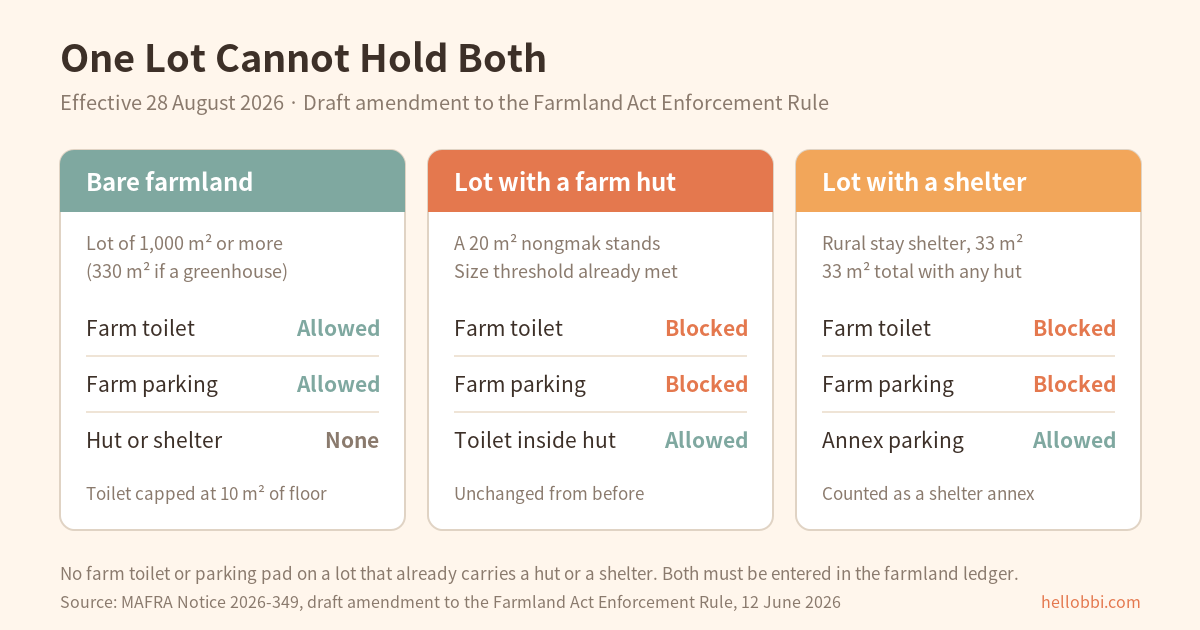
From 28 August, a farmer in Korea can put a toilet on a field without applying for farmland conversion. A parking pad too. The amended Farmland Act passed the National Assembly on 7 May and takes effect that day, with an enforcement rule carrying the details. One condition kills it, though. The lot must not already have a farm hut or a rural stay shelter on it.

Two things get the free pass, and only two
I read the draft rule the Ministry of Agriculture published on 12 June. It is Notice 2026-349. Two new items appear: a “farmer toilet” and a “farmer parking area.”
The toilet is capped at 10 m² of floor area. That is about 108 square feet. You still file a temporary-structure notice under the Building Act.
The parking area is capped at 25 m² of ground. Two cars, roughly. It has to touch a farm track or a path in long use. If it spans two lots, it cannot sit on the boundary line.
Both need a lot of at least 1,000 m². That is a quarter acre. The floor drops to 330 m² if the lot already carries a greenhouse or similar production structure. Both must also be entered in the farmland ledger.
The ledger entry is not paperwork for its own sake. It means the county keeps watching what stands on the field. It runs with the nationwide farmland audit the government started in May.
A hut on the lot cancels the whole thing
The draft carries this line: the facility “shall not be installed on a lot where a nongmak or a rural stay shelter has been installed.”
A nongmak is a farm hut. Korean law allows one of up to 20 m² on farmland for resting during work. If one stands there, neither the toilet nor the parking pad is available.
The logic is easy enough to guess. A toilet inside a hut was always permitted. A shelter can carry parking as an annex. Allow one more outside and structures keep piling onto farmland.
So it becomes a choice. Put up a hut and build the toilet inside it, or skip the hut and put a toilet outside on its own.
You also have to count as a farmer
City residents mostly fall out here. The clause is named for farmers, and the name is doing work.
Korea sets four ways to qualify. Farm 1,000 m² of land, or 330 m² under structures. Or work 90 days a year in agriculture. Or sell more than ₩1.2m of produce a year. Any one of them counts.
The catch is how a city resident buys farmland at all. Under the weekend-farming route, you may own less than 1,000 m² in total. That ceiling is in the Farmland Act.
And the toilet rule wants a lot of 1,000 m² or more. The two numbers meet head on.
Buy a weekend plot and you cannot use this clause. The lot is too small. Putting up a greenhouse drops the bar to 330 m², but that is not what a weekend gardener does.
The government’s own June briefing points the same way. It talks about women farmers with nowhere to go during a long day in the field, and about tractors with nowhere to park. This was never aimed at second homes.
What is left for city people is the shelter
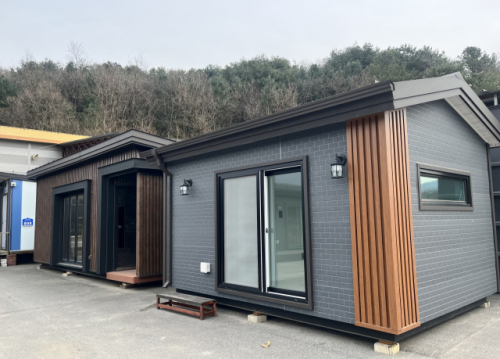
A different door is open. The rural stay shelter arrived in January 2025.
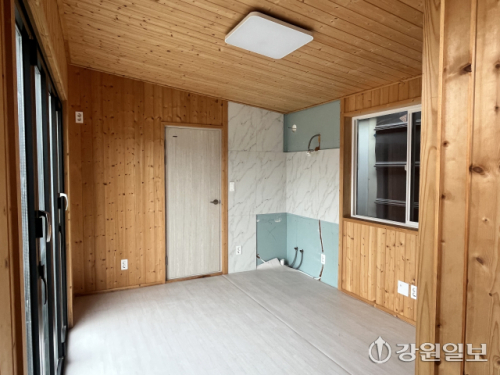
It is a temporary lodging you place on farmland you own. Floor area 33 m², about 355 square feet. Sleeping and cooking are allowed. It can stand for up to 12 years.
Housing law treats it as a non-dwelling. So it does not touch capital gains tax or the comprehensive real estate tax. That matters if you already own the one home you live in. Buy a second house in the provinces and you become a two-home owner. A shelter does not add to the count.
People are already moving. Ministry figures show 2,592 shelter applications filed in Gangwon province alone between 24 January and the end of December 2025. South Chungcheong followed with 2,124, North Gyeongsang with 1,767, North Chungcheong with 1,613.
Forests got a version of this in July. It is called the mountain village stay shelter, and it goes on woodland you own.
Site under 100 m², building under 33 m². The permit runs three years and renews as often as the local building ordinance allows. You file the land-use notice on the Forest Service portal and the structure notice on the building portal.
No fire, though. No burning and no cooking equipment. Landslide-risk zones are off limits.
The ministry’s own Q&A video on shelters. Korean only, but it walks through the filing screens, which is faster than reading the notice.
Where the money actually splits
I costed only what goes on top of the land. Land price aside, it lands in three tiers.
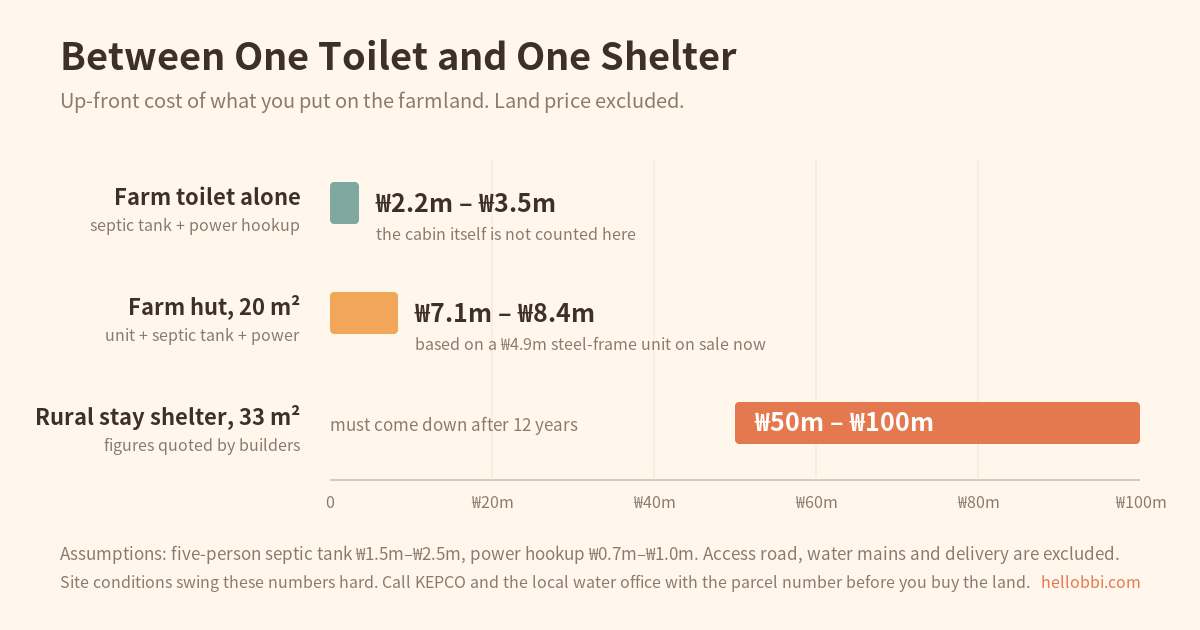
The bare toilet is cheapest. A five-person septic tank runs ₩1.5m to ₩2.5m in most reports. A power hookup, meter and utility charges included, runs ₩0.7m to ₩1.0m.
A hut adds the unit itself. One steel-frame maker sells a gabled 20 m² box at ₩4.9m and says the price has held for three years.
The shelter is a different order. Builders quote ₩50m to ₩100m. It is a small house, so that tracks.
Plenty is missing from those numbers. Access road, water mains, a drilled well, delivery. Every forum thread says the same thing: call KEPCO and the local water office with the parcel number before you buy. Some land simply cannot be hooked up.
The 12-year teardown is the part people miss
A shelter may stand 12 years. After that it comes down.
That means demolishing something you spent ₩50m to ₩100m on. Builders say buyers sign without knowing this. Or they know and assume it will sort itself out later.
There is talk of letting local ordinances extend the term. Nothing is settled.
The filing side is noisy too. Owners report slow answers from county offices. Some counties ask for a farm business registration or a garden use plan on top of the rule. Same law, different counter.
The title of that one reads “I should have just built a hut.” The argument is that 33 m² is not automatically better. Triple the price for weekend use changes the arithmetic.
What to check on 28 August
What exists today is the 12 June draft. The comment window closed on 22 July. Numbers can move between draft and promulgation.
Three things are worth checking. Whether the 1,000 m² floor survived. Whether the hut-and-shelter exclusion stayed in. And how much of the toilet specification got pushed down into a ministerial notice.
Whether a weekend-sized plot ever gets a path here, I cannot tell yet. I will write again once the final text is out.
Tax treatment turns on individual circumstances, so confirm anything binding with a tax professional.
Sources
- MAFRA Notice 2026-349, draft amendment to the Farmland Act Enforcement Rule (12 June 2026)
- Financial News, “Parking allowed on fields, stay shelters in the forest” (30 June 2026)
- Nongmin Sinmun, “Not alongside a hut — the standard for toilets and parking on farmland” (15 June 2026)
- Kangwon Ilbo, “Gangwon leads the country in rural stay shelters” (6 March 2026)
- Countryhome Life, “The mountain stay shelter: the rule opened, the market has not” (June 2026)
- Korea Easy Law, “Using farmland for weekend and hobby farming”
- National Agricultural Products Quality Management Service, farm business registration guide
Leave a Reply