A comment window closes tomorrow. Korea’s Ministry of Economy and Finance put a draft amendment to the Comprehensive Real Estate Holding Tax Act out for public comment on 4 August. Comments close on 20 August.
The tax, usually shortened to jongbuse, is a national surtax on top of local property tax. It only bites above a deduction floor, so the floor is what matters. Today that floor is ₩1.2 billion of assessed value for a one-home household.
The bill splits that in two. Live in the house and you get ₩1.4 billion. Own it and live elsewhere and you get ₩900 million.
Multi-home owners get a formula instead of a number. It is ₩400 million plus ₩500 million times the share of your total assessed value that your own home represents. Live in none of them and you keep only the ₩400 million.
The change applies from the 2027 tax year. Assessment day is 1 June, so the first bill under the new rules arrives in December 2027.
Above ₩2.6 billion, living there stops helping
The headline read as a win for owner-occupiers. It is only half a win.
The deduction rises, but so does the fair-market ratio. That is the multiplier applied to assessed value when the tax base is set. It goes from 60% to 70% in 2027, and to 80% in 2028 for anyone with three or more homes or a home in a regulated zone.
The two forces cross at a specific number. Work it out and it lands at ₩2.6 billion of assessed value.
Below that, the bigger deduction wins. Above it, the higher ratio wins and even a resident owner sees a larger tax base. Market price at that point is roughly ₩3.7 billion.
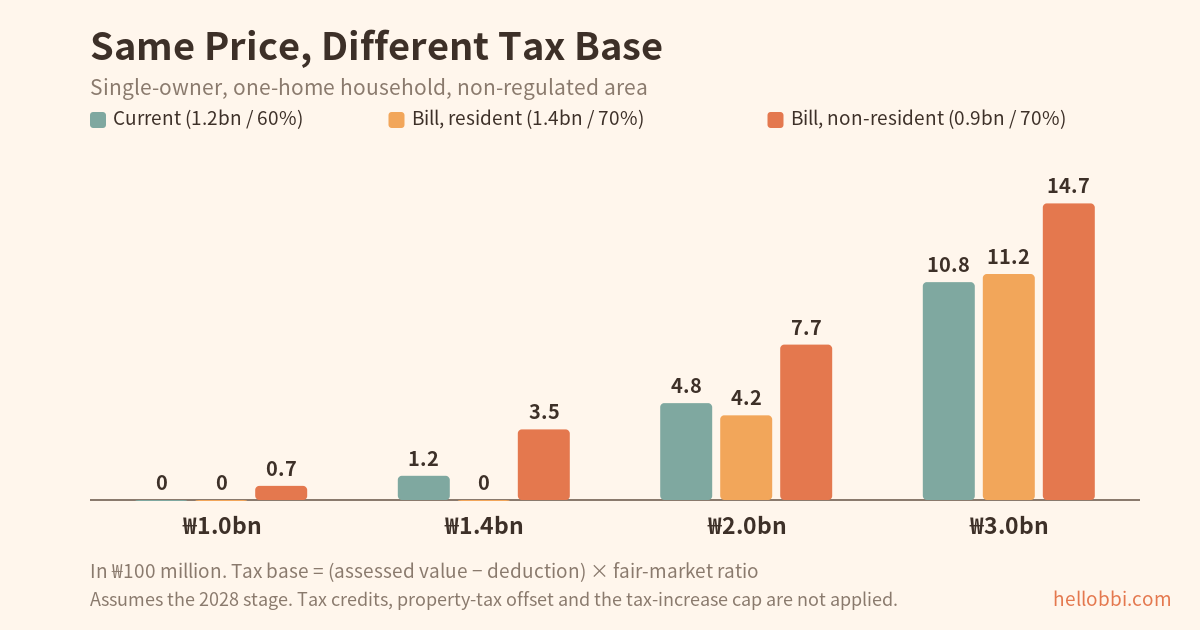
Take a home assessed at ₩1.0 billion. A resident owner has a tax base of zero. A non-resident owner has ₩70 million.
At ₩1.4 billion the gap opens. The resident is still at zero. The non-resident is at ₩350 million.
At ₩2.0 billion, today’s ₩480 million falls to ₩420 million if you live there and rises to ₩770 million if you do not. Same house, three answers.
Thirty days for the bank, one year for the tax office
This is the confusing part. Two arms of government define “living there” differently.
The Financial Services Commission announced mortgage and lease-loan measures on 13 August. If you own an apartment in the capital region or a regulated zone, rent it out, and neither you nor your spouse has ever lived in it, your jeonse loan guarantee is blocked. New loans and rollovers both.
One stay is enough to escape it. You need to have lived there and registered your residence. Article 6 of the Resident Registration Act treats a stay intended to last 30 days or more as registrable. Thirty days clears the bar.
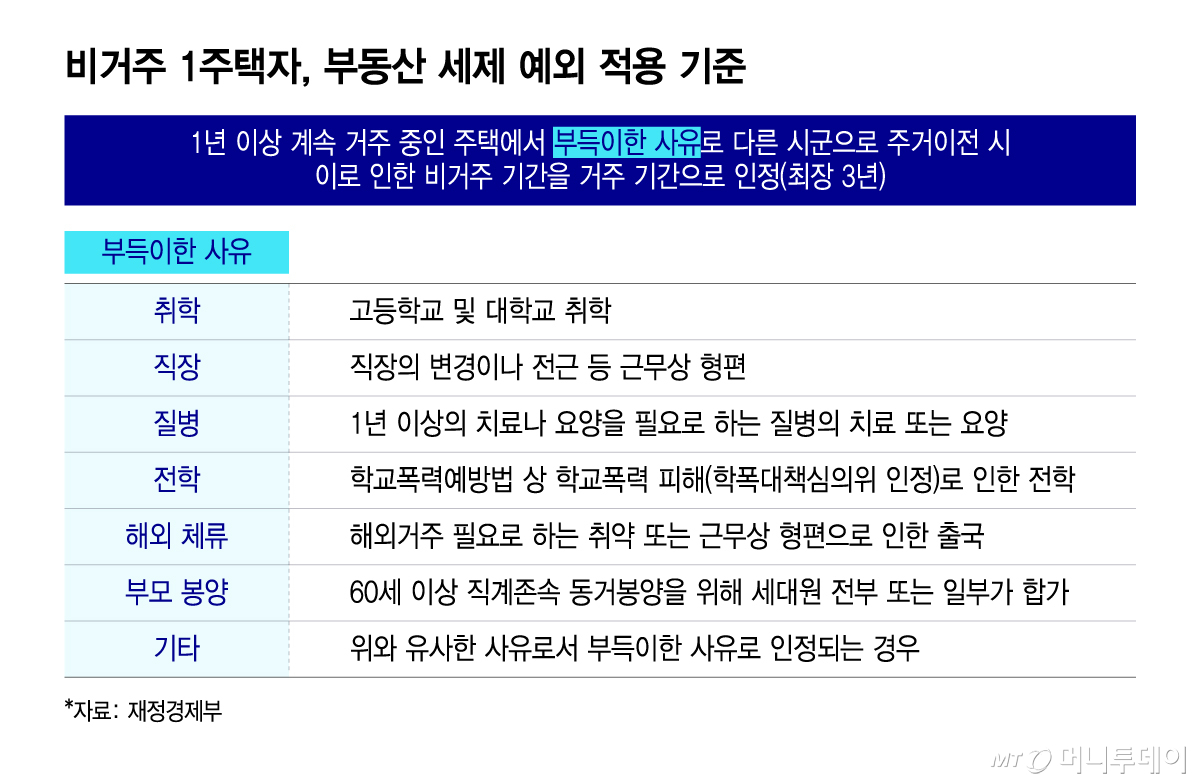
The tax rule is stricter. To claim an unavoidable-absence exemption you must have lived in the home continuously for at least a year first. Then you must move to a different city or county.
The reasons are listed, not open-ended. High school or university enrolment, a job change or transfer, illness needing a year of treatment, a transfer after school violence, going abroad for study or work, and moving in to care for a parent aged 60 or over. Up to three years counts as residence.
A ministry official told Money Today that finance and tax are different by nature. Lending looks at a moment in time, capital gains tax looks at the whole holding period.
That explanation does not reach the holding tax. The basic deduction ignores duration entirely. It asks one question: do you live there or not.
For a foreign resident this matters in a specific way. Being posted abroad by your employer counts as an accepted reason, but only if you lived in the home for a year first and can prove the move abroad.
Jointly owned homes need a fresh decision every September
This tax is assessed per person, not per household. So a couple holding one home jointly has two ways to be taxed.
One is separate filing, each on their own share. The other is a special election that treats one spouse as a one-home household.
A couple living in the home who file separately get ₩900 million each. That is ₩1.8 billion together, the same as now.
A couple who do not live there get ₩400 million each. That is ₩800 million. A billion won of deduction disappears.
In that case the special election gives ₩900 million and wins. If you do live there, separate filing at ₩1.8 billion wins. The better answer can flip from year to year.
The election window is 16 to 30 September. That is true today and stays true after the change. It is worth a calendar entry.
There are 8,100 comments and they are not polite
The government’s public comment portal filled up fast. By 2pm on 12 August the holding tax bill alone had over 5,300 comments. Add 2,570 on the income tax bill and the two clear 8,100.
Most oppose the bill. The loudest single request is to widen the exemption list.
A national civil servant wrote that rotating posts every year makes non-residence unavoidable. “Am I supposed to buy property at every posting?”
Another had lived five months in a newly built apartment before being sent overseas. Five months is seven months short of the rule. “Why does it have to be a year?”
The comments from older owners are sharper. One called it a modern version of abandoning the elderly on a mountain.
The government moved. It said publicly that it will revise the bill before sending it to parliament.
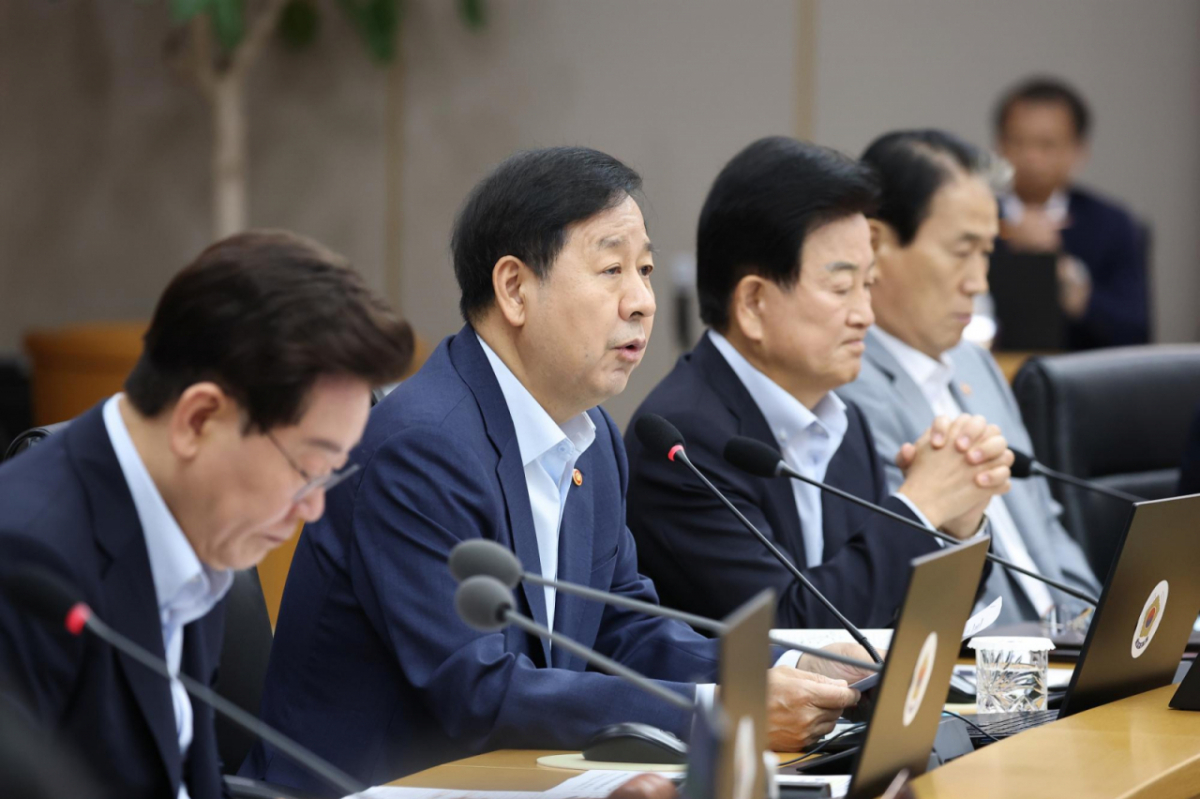
Deputy Prime Minister Koo Yun-cheol said so at a cabinet meeting on 11 August. He promised to hear out the comments through the 20th and amend accordingly.
That is unusual. The ministry normally holds its line and lets the National Assembly do the editing.
How the tax got here
Until now the axis was the number of homes. Rates split at two homes versus three. The deduction was ₩1.2 billion for one home and ₩900 million for anything else.
Under that frame one expensive home was lighter than two cheap ones. The bill moves the axis to value and residence. From 2028 the headcount-based rate split disappears entirely.
Tax credits follow. Today a long holding period earns up to 50%. From 2028 it is years lived instead, and a cash cap appears: ₩8 million in 2027, ₩6 million from 2028.
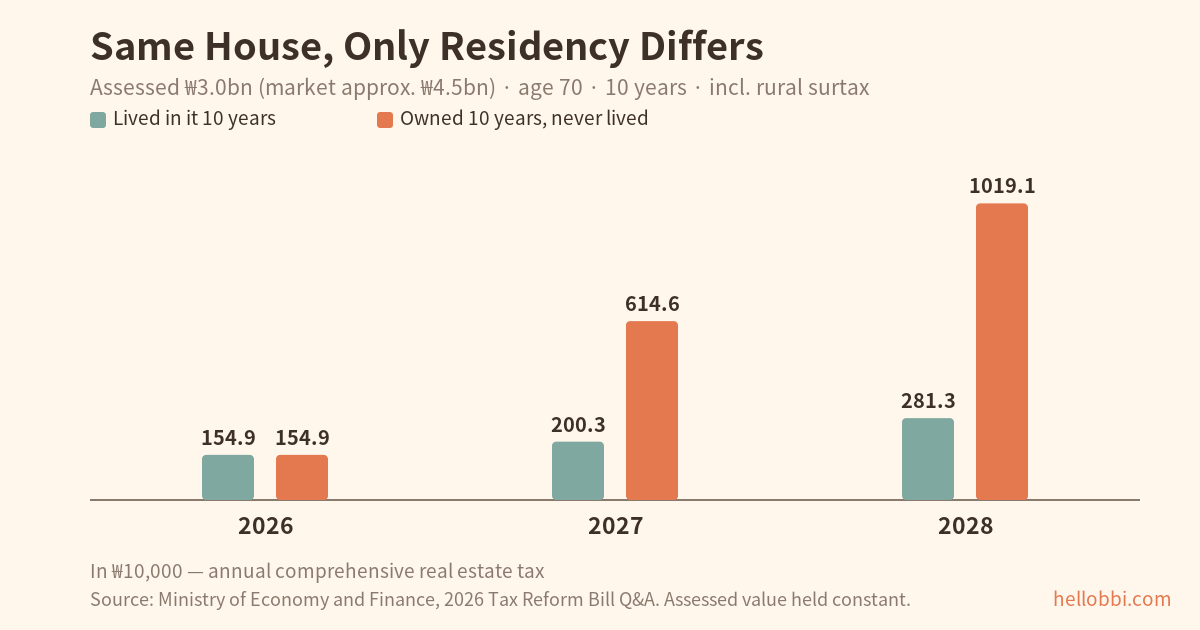
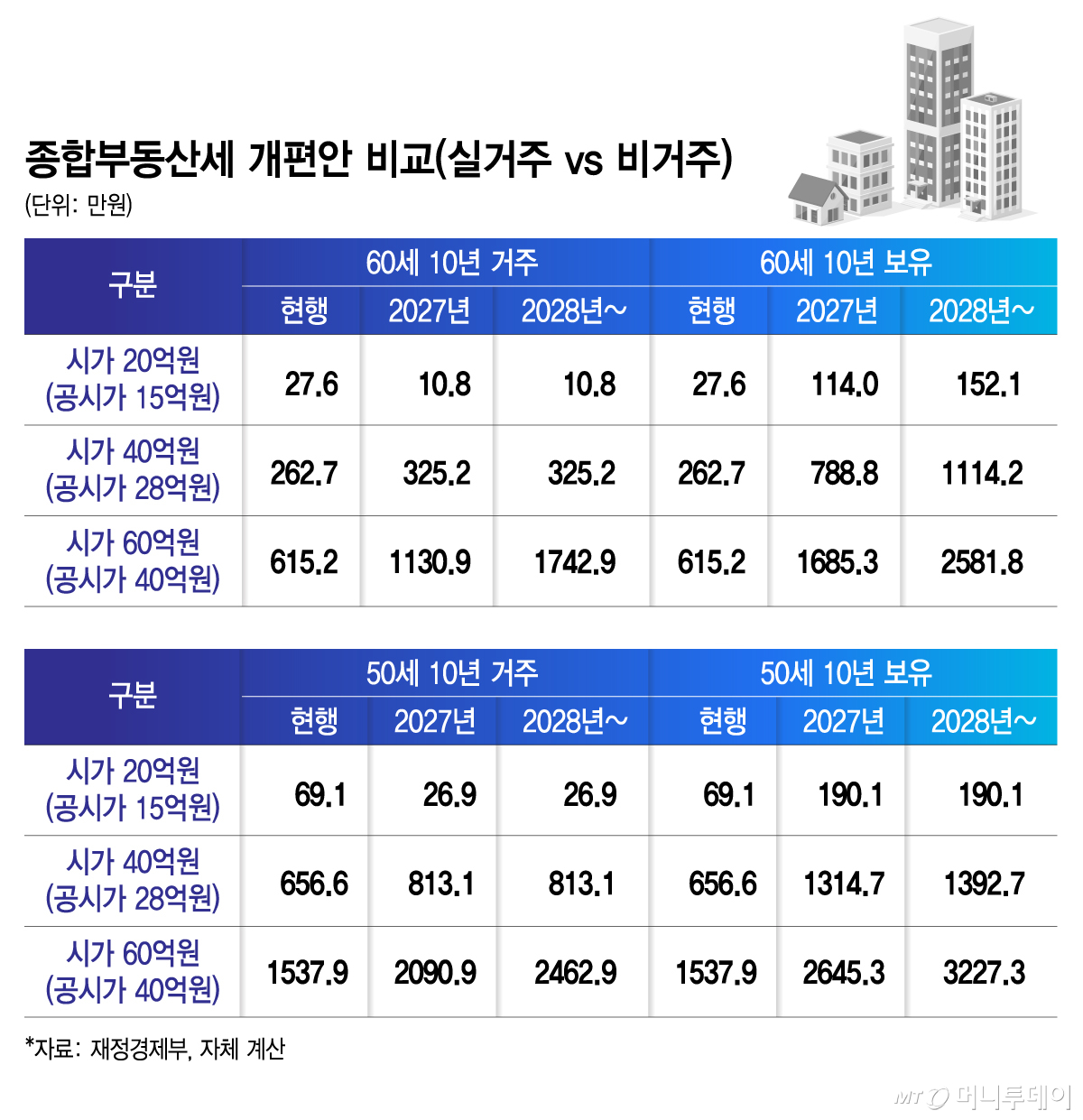
The ministry published a worked example. A 70-year-old with a home assessed at ₩3.0 billion, held ten years.
Ten years lived in gives ₩2.81 million in 2028. Ten years owned but never lived in gives ₩10.19 million. In 2026 both pay ₩1.55 million.
The reverse case is real too. A 60-year-old who lived ten years in a home assessed at ₩1.5 billion drops from ₩276,000 to ₩108,000.
The Korea Economic Daily walked through the bill on the day it landed. It is in Korean, but the on-screen tables carry most of the numbers.
None of this is law yet
This is a government draft. It is not enacted.
Cabinet approval is set for 1 September and submission to the regular session before 3 September. Rates, caps and start dates can all shift there.
The governing party is split on it. Song Young-gil, running for party leader, said on radio on 13 August that property taxes should be left alone. He put the extra revenue at about ₩1 trillion against ₩50 trillion coming from elsewhere.
The whole reform package is costed at ₩3.44 trillion over five years. The holding tax changes are a large share of that.
Two questions stay open. How far the softened exemptions go, and whether the tax and lending definitions of residence ever converge. The first gets answered in early September. On the second, the ministry has already said it sees no reason to align.
Rates, deductions and dates are as of 19 August 2026. Individual circumstances vary, so confirm anything binding with a licensed tax accountant.
Sources
- Ministry of Economy and Finance, 2026 Tax Reform Bill, detailed release, 3 August 2026 — full PDF
- Ministry of Government Legislation, public comment page for the Comprehensive Real Estate Holding Tax Act amendment (4–20 August 2026)
- Money Today, “Thirty days counts as living there? Tax and finance disagree on the non-resident single-home owner”, 17 August 2026
- Money Today, “Government to widen non-residence exemptions after backlash”, 13 August 2026
- Newsis via Financial News, “Over 3,000 comments on the holding tax bill”, 10 August 2026
- Hwanhui Tax Accounting, before-and-after comparison of the holding tax changes, citing the ministry’s Q&A examples
- Comprehensive Real Estate Holding Tax Act, Article 8 (current deductions of ₩1.2bn and ₩900m; fair-market ratio range of 60–100%)
Leave a Reply