On August 13, Korea’s government slipped an unusual product into its latest real-estate package: the Youth Future Bogeumjari Loan. From January 2027, first-time buyers aged 39 or under can borrow up to 80% of a home worth ₩400 million or less, at a rate of around 3%. The catch is in the fine print – it only works for non-apartment housing: villas, officetels, and multi-family row houses.
A quick note on vocabulary. In Korea, a “villa” is not a holiday home – it is a small low-rise apartment building, usually cheaper and far less liquid than the big-brand apartment complexes everyone actually wants. Bogeumjari loans are the state-backed fixed-rate mortgages issued through the Korea Housing Finance Corporation (HF).

Six conditions, and you need all of them
You must be 39 or younger, buying your first home ever, with annual income of ₩70 million or less. For newlywed couples, only one spouse needs to clear the income bar. The home must be a non-apartment, priced at ₩400 million or under, with floor area of 85㎡ or less.
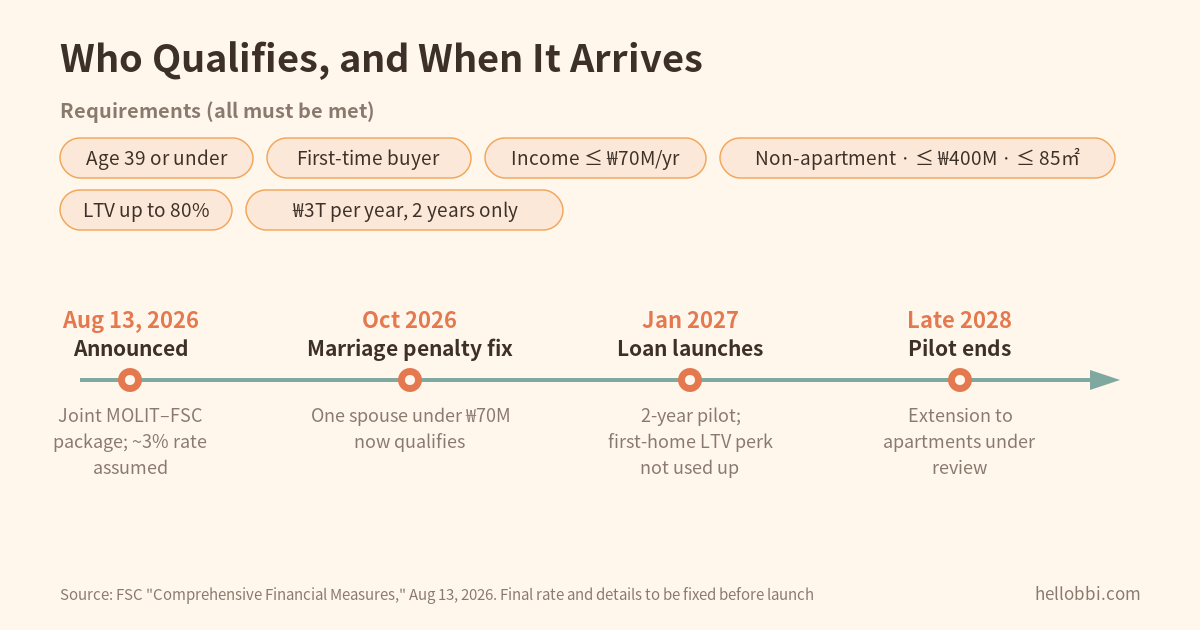
The 3% figure is a working assumption, not a confirmed rate. The Financial Services Commission (FSC) says it wants “around 3%,” with extra discounts for low-income buyers, buyers outside Seoul, and families with newborns. Supply is capped at ₩3 trillion a year, for two years only.
We ran the monthly numbers
Here are our assumptions: the loan covers 80% of the price, repaid over 30 years in equal installments. We compared the new 3.0% rate against 5.2%, the current upper rate on the regular Bogeumjari loan as of August.
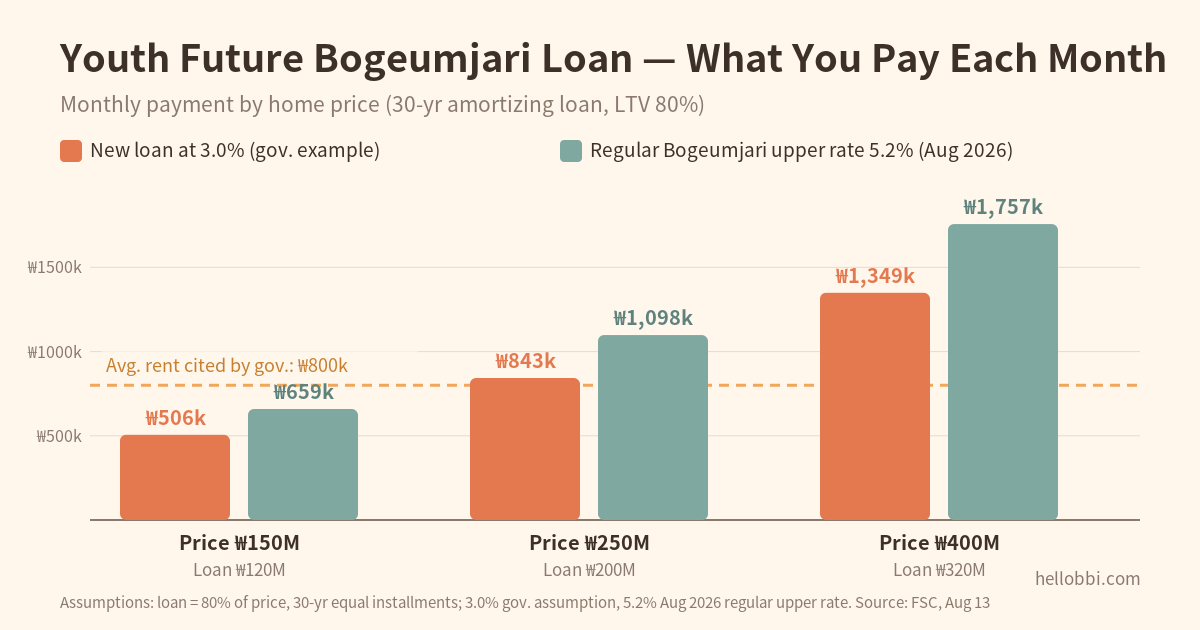
A ₩150 million home costs about ₩506,000 a month. Max out the ₩400 million limit and it is ₩1.35 million. On the regular product’s upper rate, those same loans cost ₩659,000 and ₩1.76 million.
Over 30 years the gap compounds. On a ₩200 million loan, total interest is roughly ₩104 million at 3.0% versus ₩195 million at 5.2% – a difference of more than ₩90 million. Commercial bank mortgages currently run 4.79-7.52%, so the rate itself is a real subsidy.
The real carrot is not the rate
Korea gives first-time buyers a one-time LTV bonus – a card you normally burn the moment you buy anything. Under this program, buying a villa does not use up that card. You can still claim the first-home LTV break (70% in regulated zones, 80% elsewhere) later, when you trade up to an apartment.
Dual-income couples get a separate fix from October 2026. Today, newlyweds qualify for Bogeumjari loans only if combined income stays under ₩85 million – the infamous “marriage penalty,” where tying the knot shrinks your borrowing options. Under the new rule, it is enough for one spouse to earn ₩70 million or less.
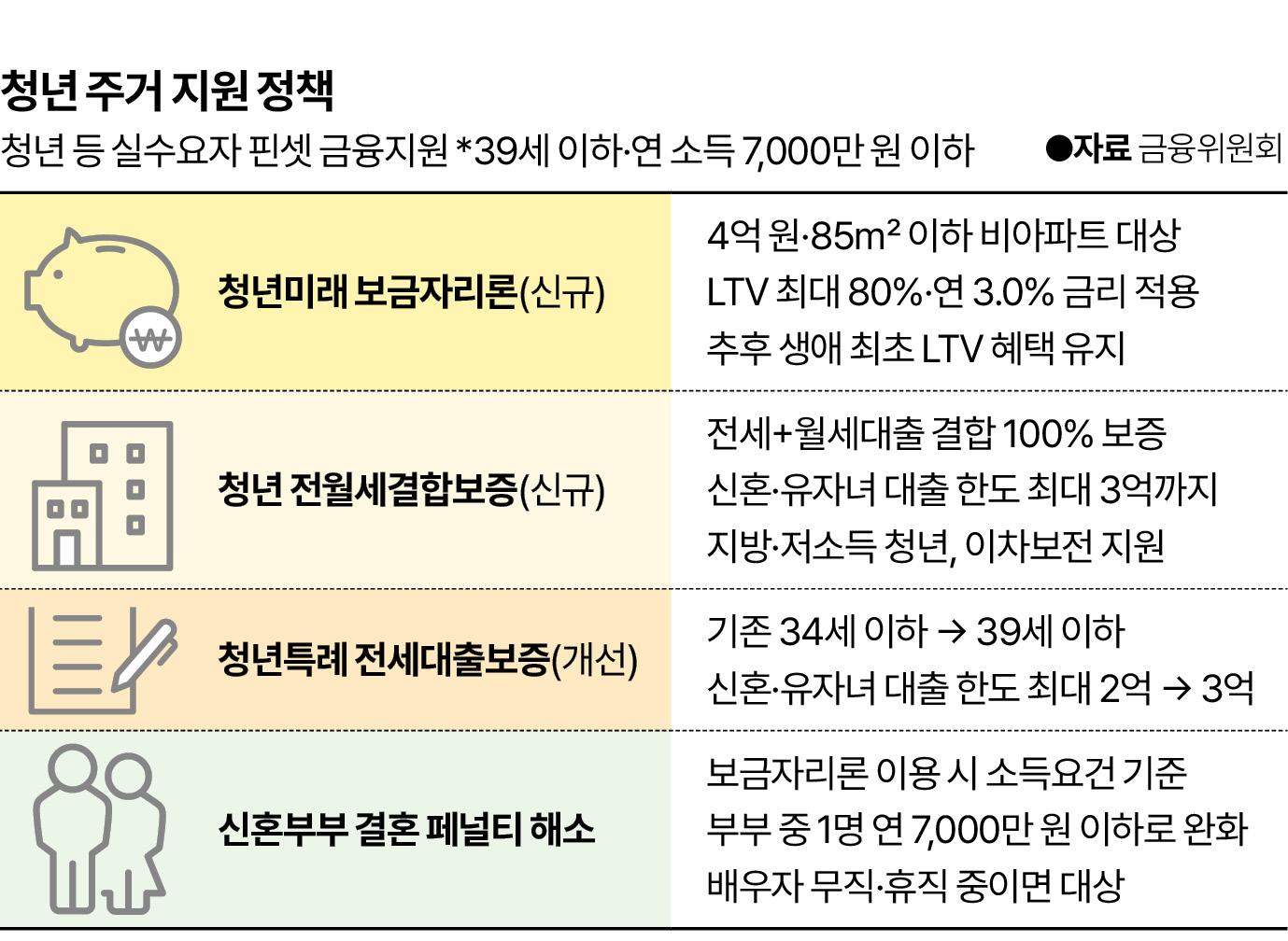
Rental support changes too. A new combined guarantee covers half-jeonse arrangements (deposit plus monthly rent), and the age limit on the youth jeonse guarantee rises from 34 to 39. Limits go up to ₩200 million, or ₩300 million for newlyweds and families with children.
Young Koreans are not impressed
The online reaction has been brutal. “So young people should just live in villas?” was the recurring comment, along with sharper versions accusing the government of using young buyers to absorb unwanted housing stock. One viral forum post called the policy a “villa clean-up operation.”
The anger has context. After Korea’s massive jeonse-fraud wave, which hit villa tenants hardest, demand for non-apartments collapsed – villas are now hard to resell at a fair price. Last year, 97% of the ₩12 trillion in Bogeumjari loans taken by young borrowers went to apartments.
The FSC’s defense: this is an added option, not a substitute, and apartment buyers keep every existing benefit. That framing seems fair to us – the product suits a single renter tired of watching ₩800,000 vanish every month, and suits nobody who plans to flip into an apartment within a few years.
One more thing if you hold a foreign passport
HF policy mortgages have historically been limited to Korean nationals, and the announcement says nothing about opening this one to foreign residents. If you are a long-term resident hoping to use it, wait for the launch notice before making plans. Commercial banks remain the realistic route for non-Koreans buying property here.
What is still open: the final rate, whether the program extends to apartments after the two-year pilot, and whether villa prices hold up enough to make this a rational buy. We will revisit when the launch terms are published in January.
Leave a Reply