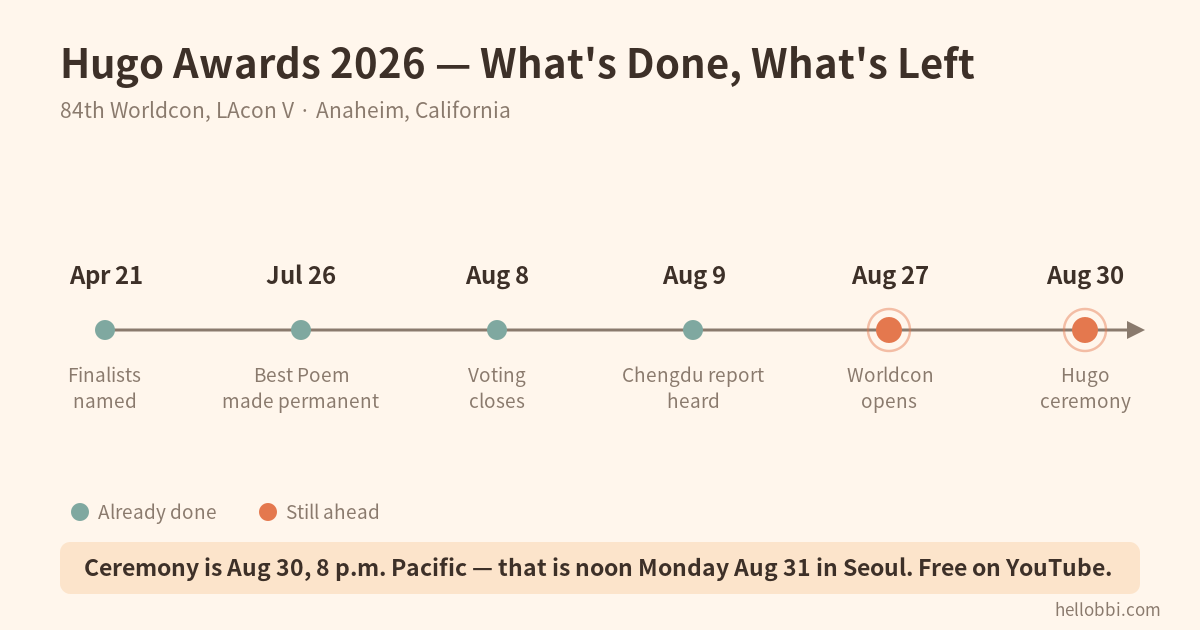
The 2026 Hugo Awards are handed out on Sunday, August 30, at 8 p.m. Pacific, in Anaheim, California. In Seoul that is noon on Monday the 31st.
Four names on this year’s ballot are Korean. Two directors, two writers. Not one of them wrote in Korean.
That is not a coincidence. The Hugos have no category for work in translation, and no proposal to create one reached this year’s agenda.
The ceremony streams free, and voting is already over
LAcon V, the 84th Worldcon, runs August 27 to 31. The Hugo ceremony is the Sunday evening event. It streams free on YouTube, so you do not need a membership to watch.
Ursula Vernon hosts. Most readers know her as T. Kingfisher.
Twenty-one categories will be presented. Voting closed at noon on August 8, so nothing is left to influence. The results are already sitting in a spreadsheet somewhere.
Two of the six film finalists were directed by Koreans
Best Dramatic Presentation, Long Form has six finalists. Two are Korean-directed.
KPop Demon Hunters was co-directed by Maggie Kang and Chris Appelhans. Mickey 17 is Bong Joon Ho’s.
Kang has said Bong was the director who influenced her most. They are now sitting in the same category.
The other four are Andor season two, Guillermo del Toro’s Frankenstein, Ryan Coogler’s Sinners, and James Gunn’s Superman.
650 members submitted nominating ballots in this category, naming 149 different works. The six finalists drew between 85 and 313 nominations. LAcon V has not said which one took the 313.
Three Korean American writers made the fiction ballot, and one was ruled out
Isabel J. Kim is a Best Short Story finalist for “Wire Mother.” She is a Korean American writer based in New York.
H.H. Pak is up for Best Novelette with “Never Eaten Vegetables,” and is also an Astounding Award finalist for Best New Writer. Pak was born in Los Angeles to Korean immigrant parents.
Silvia Park drew enough nominations for the Astounding ballot but was ruled ineligible. The administrators found a qualifying publication from before 2024, which means she no longer counts as new.
Her novel Luminous is set in a future Seoul. It was shortlisted for the Arthur C. Clarke Award and won this year’s LA Times Science Fiction Book Award. It is a strange thing to be too accomplished to be a new writer.
Both finalist stories are free to read right now. Clarkesworld puts its full text on the open web.
Korean-language fiction has nowhere to go on this ballot
Every Korean name above belongs to someone who writes or works in English. Nothing originally written in Korean is on the ballot.
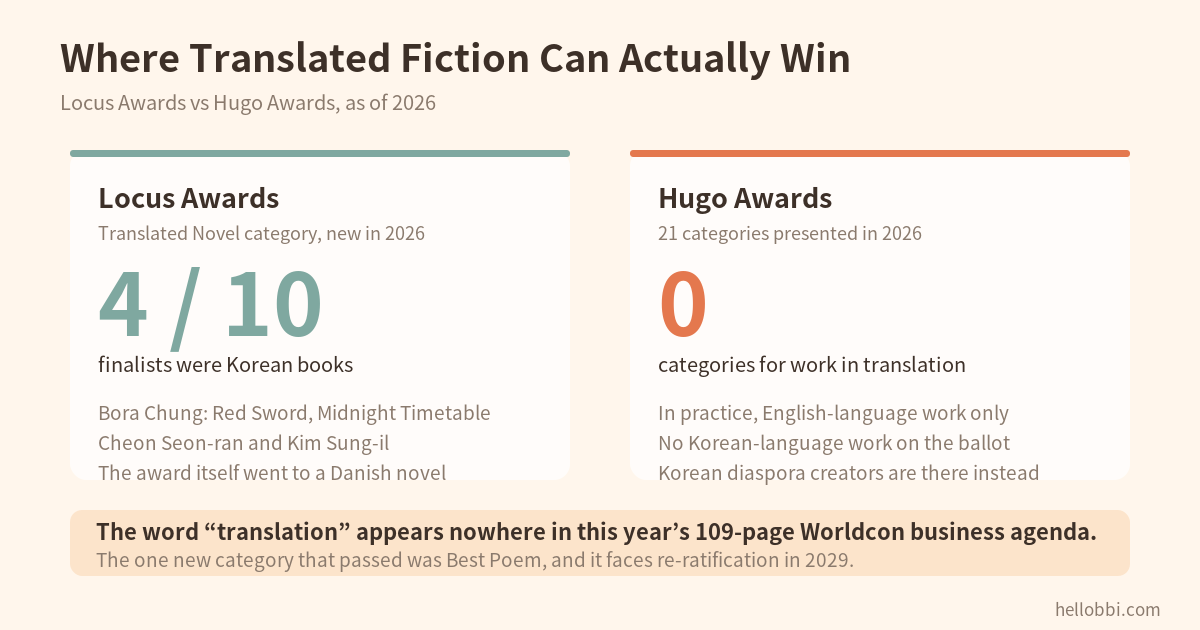
The structure explains it. None of the 21 Hugo categories is open to work in translation on its own terms, so English-language publication is the practical entry requirement.
The Locus Awards went the other way. They added a Translated Novel category this year. Four of the ten first-year finalists were Korean.
Bora Chung had two — Red Sword and The Midnight Timetable, both translated by Anton Hur. Cheon Seon-ran and Kim Sung-il took the other two. The award itself went to a Danish novel.
Campaigners for a translated-fiction Hugo do exist. They did not get a motion filed this year.
We read the business meeting agenda to check. It runs 109 pages. The word “translation” does not appear once.
The only new category that passed was Best Poem, ratified on July 26. It carries a sunset clause: unless the 2029 meeting re-ratifies it, it is repealed.
The 2023 Chengdu affair is still being settled
The August 9 business meeting was held entirely in executive session. Its business was a Trial Committee report on how the 2023 Hugos were administered in Chengdu, China.
The meeting censured individuals by name and asked future Worldcons to bar them from membership and volunteering.
The names are not public yet. The text of the resolutions is released once the final session adjourns on August 30.
The short version of what happened: in 2023, eligible finalists were quietly ruled out with no reason given. R.F. Kuang’s Babel was the best-known case.
Leaked emails later showed administrators combing nominees’ social media and old interviews for references to Hong Kong, Taiwan and Tibet — anything the host government might dislike.
Readers have not forgotten. When Kuang’s Katabasis missed the Best Novel ballot this year, one commenter wrote that “the memory of Babel‘s wrongful exclusion” should have been enough to push it over the line.
What to actually do this week
Open YouTube at 8 p.m. Pacific on Sunday. That is the whole instruction. No membership, no payment.
If you want to read something first, take the two Clarkesworld finalists — Isabel J. Kim’s and H.H. Pak’s. Both are short and free.
The open question is the translation category. Locus created one and Korean books took four of ten slots immediately. The Hugos cannot do the same thing quickly.
A constitutional amendment has to pass at two consecutive business meetings. With nothing filed in 2026, the earliest a translated Hugo could be awarded is 2028.
Sources
- 2026 Hugo Awards — full finalist list and nominating statistics (official)
- The Hugo Awards — LAcon V (ceremony time, streaming, voting deadline)
- WSFS Business Meeting Recaps — LAcon V
- 2026 WSFS Business Meeting Agenda (109pp, PDF)
- Korean SF shines in Locus Awards shortlist — The Korea Herald
- 2026 Locus Awards Winners — Locus
- LAcon V Announces 2026 Hugo Awards Finalists — File 770
- Hugo 2026 Finalists — Camestros Felapton (reader reaction)
Leave a Reply