On August 13, the Korean government rolled out a new housing-finance package. It moves in two directions at once. Lending caps got looser, and jeonse loans got tighter.
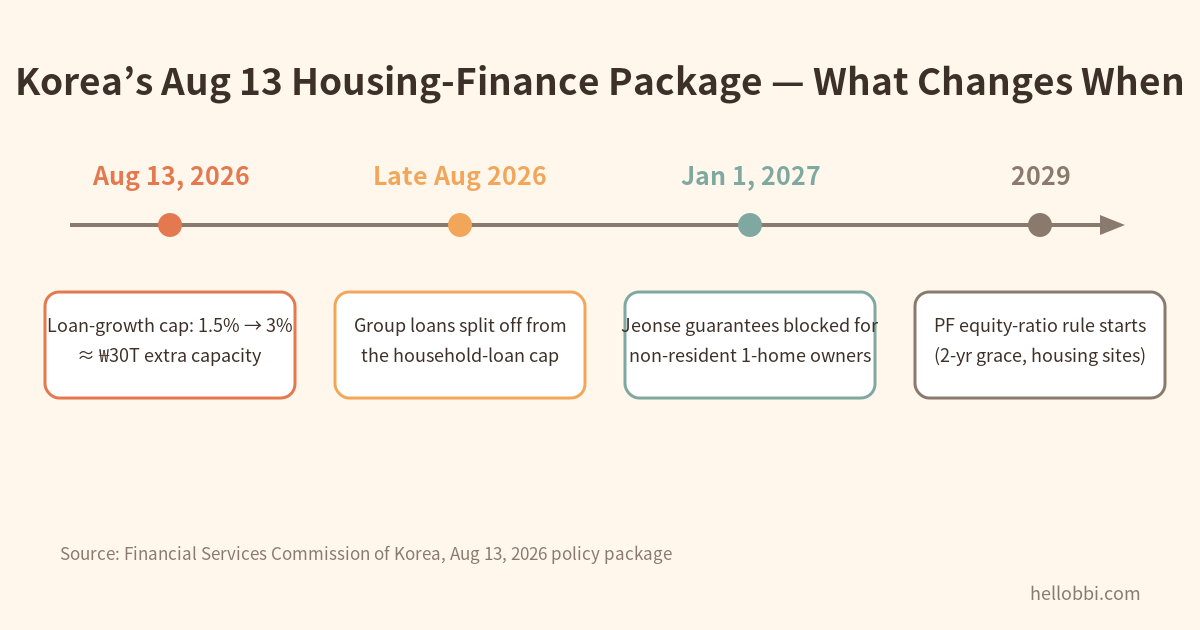
The household-loan growth target for 2026 doubled, from 1.5% to 3%. That frees up roughly ₩30 trillion in lending capacity. And from January 1, 2027, owners who never lived in the home they bought lose access to jeonse loans.
First, the loosening: the loan spigot reopens
Some background helps here. Korea caps how fast total household lending can grow each year. The 2026 target of 1.5% was set below last year’s actual growth of 1.7%, and banks burned through their quotas by early summer.
The result was what Koreans called “loan open runs” — borrowers logging in the moment a bank’s daily window opened, then trying the next bank when it closed. Buyers of newly built apartments were hit hardest. Many faced move-in dates with no balance-payment loan available.
The fix has two parts. The overall cap rises to 3%, and group loans — interim, balance, and relocation loans tied to new apartment projects — are pulled out of the cap entirely and managed separately.

Then, the tightening: jeonse loans for absentee owners
Jeonse is Korea’s lump-sum deposit rental system: instead of monthly rent, tenants hand over a large deposit, usually financed with a bank loan backed by a state-linked guarantor (HF, HUG, or SGI). No guarantee, no loan — which makes the guarantee rules a powerful policy lever.
From January 1, 2027, those guarantees are cut off for a specific group: people who own one apartment in the Seoul metropolitan area or another regulated zone, rent it out to a third party, and have never lived in it — neither the owner nor the spouse. The government counts about 60,000 such borrowers holding ₩9.6 trillion in jeonse loans.
Both new loans and rollovers of existing loans are banned. That second part is what stings.
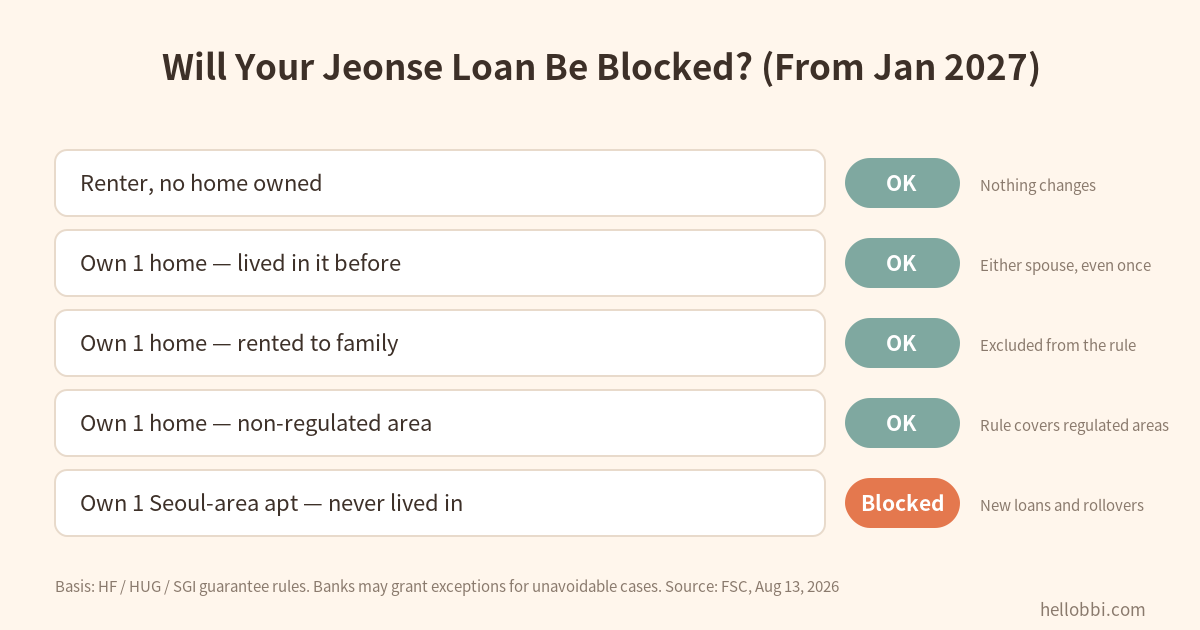
The exceptions are broader than the headlines suggest. If you or your spouse ever registered residence at the property, even once, you are out of scope. Renting to family also exempts you, and each bank’s credit committee can approve exceptions for unavoidable circumstances.
Why people are angry anyway
Blocking rollovers means people who borrowed under the old rules must repay or move when their lease term ends. Assume a jeonse loan at 70% of the deposit: a ₩500 million deposit means finding ₩350 million in cash, and a ₩700 million deposit means ₩490 million. Comment sections are full of single-home owners who rent near work or their children’s schools asking why they count as speculators.
There is also a fairness question about enforcement. The government left exception decisions to each bank’s own committee, and within days the papers were calling it responsibility-shifting. Standards may differ from one bank to the next.
For expats, one practical note: the test is household-based. You cannot dodge it by putting the home in a spouse’s name, but either spouse’s residence history counts in your favor. If you ever actually lived in the property, make sure the resident registration record exists.
Why now
Korea has run demand-side restraint since the June 2025 measures, and this year’s 1.5% cap was the tightest yet. When spring transactions surged, the quota ran out early and real buyers got stuck. So the government flipped the mix: loosen the total, and aim the restrictions narrowly at speculative demand.
The supply side got money too. Project-finance guarantees and support for housing construction expand from ₩26.3 trillion to ₩47.8 trillion-plus, and the land ministry announced 230,000-plus additional homes for the capital region the same day.
KBS’s same-day rundown above covers both halves of the package. The FSC chairman’s interview below goes deeper on the lending changes.
What is still open
Three things are worth watching. How strictly each bank actually applies the exception review. Whether the target group shifts when regulated-zone maps change. And whether ₩30 trillion of fresh lending capacity pushes prices back up — the very thing the package is meant to prevent.
The jeonse restriction is a guarantor-rule change, not legislation, so it does not need a vote in the National Assembly. Treat the January 2027 start date as fixed. We will follow up when the detailed screening standards come out.
Loan and guarantee terms depend on individual circumstances. Confirm your own case with your bank and the guarantee agency.
Leave a Reply