This month one of us started swimming and the other started boxing. Both of us are four weeks in.
I expected to be learning new movements. That is not what happens. Both sports begin by teaching you to suppress an instinct.
Swimming is learning not to lift your head when you want air. Boxing is learning not to let your wrist fold when you hit something.
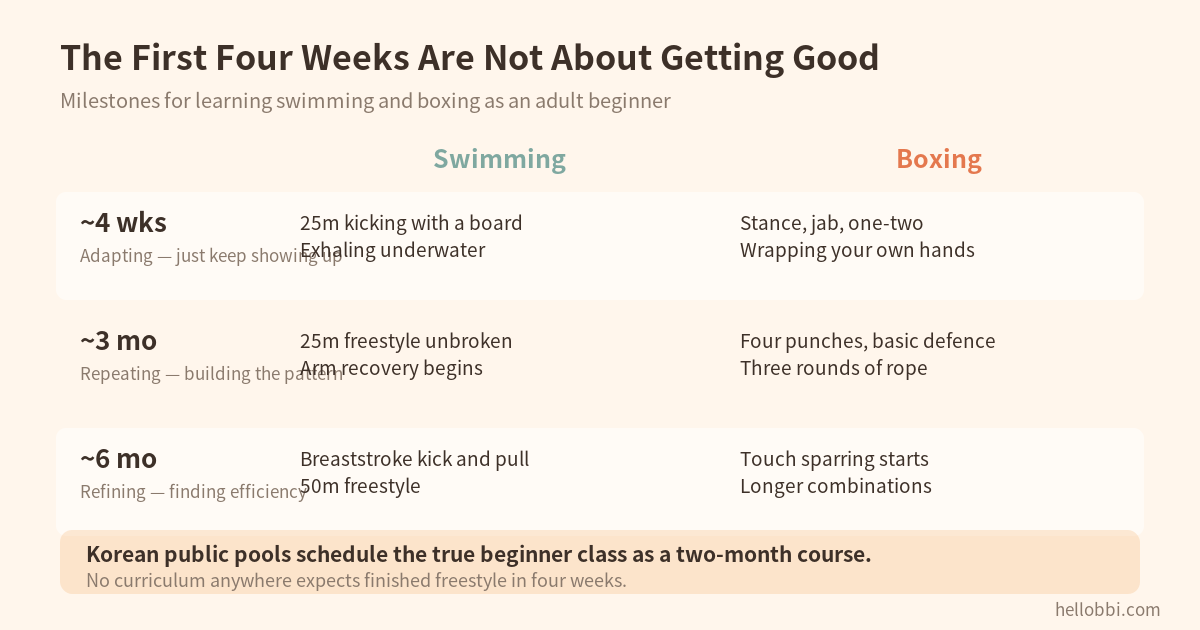
No beginner course expects finished freestyle in four weeks
Knowing this earlier would have saved some impatience.
Korea’s national sports agency publishes the progression chart for its Olympic Pool programme, which is close to the standard for public pools here.
The lowest class runs for two months. Those two months cover water confidence, freestyle kick, arm action and putting them together.
So four weeks is halfway through the beginner class. Nothing in the syllabus expects a finished stroke by then.
Breaststroke arrives in the next tier, around three months in. Butterfly is later still.
Swimming is about breathing out, not breathing in
Beginners swallow water for one main reason. They lift their face too far.
When you are short of air the head goes up ninety degrees. That levers your hips and legs downward, drag increases, and you get more out of breath.
The fix is rotation, not lifting. Roll the body until one ear is at the surface and stop there.
The breathlessness itself is also misread. It is carbon dioxide building up, not oxygen running out.
Beginners concentrate on the inhale and never exhale underwater. You cannot fill lungs that are still full.
So the real lesson of the first four weeks is continuous exhalation. Once that lands, swallowing water mostly stops.
A Korean forum post by a man in his forties has stayed with me. He described himself as a sinker and took six months to swim 25 metres without stopping.
Two of his mistakes were instructive. He put fins on too early, and the extra speed hid his own body position from him.
The other was spending all his energy on kicking. He was exhausted and sinking before 25 metres.
He also debated buying prescription goggles and concluded he did not need them. There is nothing to look at closely underwater.
Never wipe the inside of your goggles
A small thing, but it comes up every session.
Fogging is warm moisture condensing into tiny droplets on the lens. The droplets scatter light, so the view goes milky.
Spit works because saliva contains surfactants that lower surface tension. The water then spreads as a thin film instead of beading. Commercial anti-fog sprays do exactly the same thing.
New goggles already have that coating applied inside. A finger or a towel strips it off immediately.
If they fog, rinse them in pool water and swirl. Do not rub.
Boxing is about gripping safely, not gripping hard
Week one was a stance and a jab. That was all. Plus learning to wrap your own hands.
Looking into why wraps matter led me to the American Academy of Orthopaedic Surgeons.
The fifth metacarpal is the most commonly fractured bone in the hand. It is the bone behind the little finger, and the injury is called a boxer’s fracture.
It happens most often when a closed fist strikes something hard. The knuckle looks sunken afterwards. A cast runs three to six weeks.
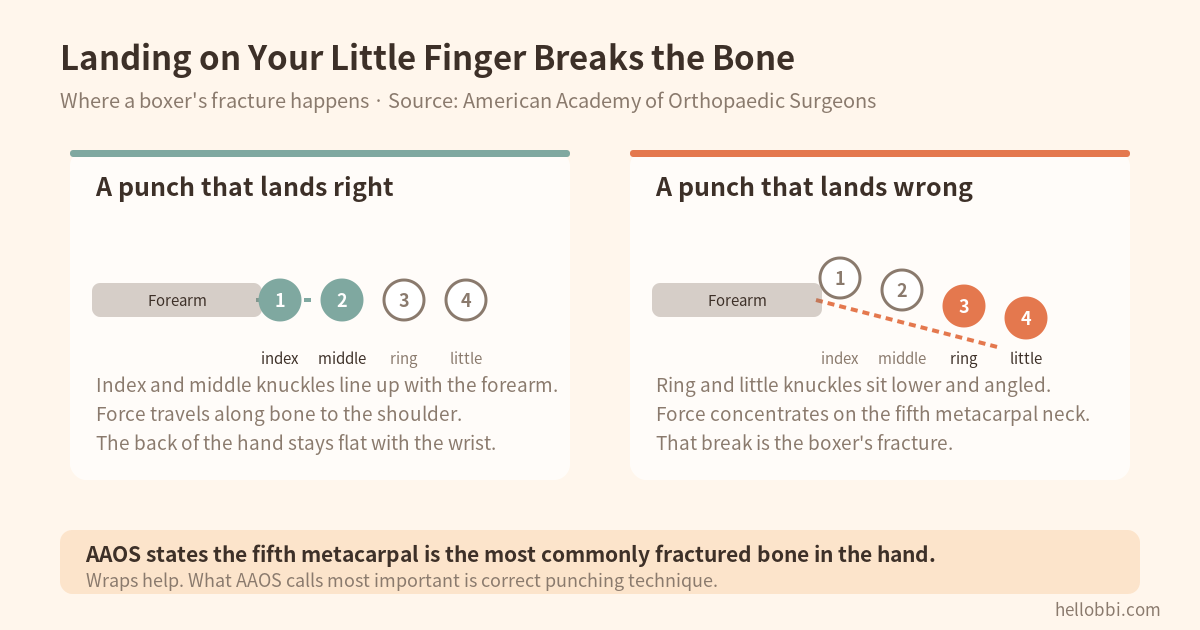
The reason it is always that side comes down to geometry.
The index and middle knuckles sit almost in line with the forearm bones. Land there and force runs up the skeleton to the shoulder.
The ring and little knuckles sit lower and at an angle. Land there and the load concentrates on the neck of the fifth metacarpal.
Wraps do three jobs. They stop the wrist folding, stop the thumb being levered back, and compress the metacarpals together.
But AAOS is explicit that the single most important factor is correct punching technique. A wrap is not absolution for bad form.
A note on glove weight. The internet keeps saying women use 8oz. That is a competition spec.
Training is different. Pads and heavy bag work call for 12 to 16oz.
A seven-year prospective study of the GB Olympic boxing squad found glove size was associated with finger fractures, thumb injuries and ulnar-side wrist pain.
Smaller gloves feel lighter and hit crisper. They also protect less.
Two things not to do at this stage
First, do not hyperventilate before going under and then hold your breath. This one is not a matter of preference.
Breathing hard first lowers blood carbon dioxide, which is what triggers the urge to breathe.
Oxygen can then fall below the level needed for consciousness while you still feel fine. You black out with no warning at all.
The Royal Life Saving Society UK publishes a standalone warning about this. Underwater distance challenges and breath-holding contests are the classic pattern.
Second, do not spar properly at four weeks.
Amateur boxing injury rates run about one injury per 772 hours of training but one per 2.5 hours of competition. The risk is concentrated somewhere specific.
The common recommendation is touch sparring somewhere between three and six months, after the basic punches, guard and footwork are in place.
A gym suggesting it does not oblige you. There are published accounts of people sparring on day ten.
One more: vomiting or hyperventilating during conditioning is not a rite of passage. Ask the coach to dial it back.
Pool rules exist for the same reason. The Olympic Pool safety code bans swimming for more than an hour straight and asks for ten minutes’ rest every fifty.
It also says to stop if you start shivering.
Those shoulder injury statistics are not about us yet
Search around and the numbers get alarming. Shoulder pain prevalence among elite swimmers is quoted between 40% and 91%.
It is worth some perspective. College swimmers exceed a million strokes per arm per year. Someone swimming three times a week is not in that population.
The risk arrives the day you decide to rush it and swim two hours daily. For now, the honest framing is that we do not yet have the body to overtrain with.
What changes at three and six months
Swimming reaches 25 metres of unbroken freestyle at around three months. Gasping for a minute afterwards is normal.
By six months breaststroke kick and pull arrive and freestyle stretches to 50 metres. This is the stretch where people report losing interest.
Boxing at three months covers the four punches and basic defence, and three rounds of rope stop being hard.
Skipping is not a warm-up. It stores energy in the calf and Achilles on landing and releases it on take-off.
An eight-week controlled trial in junior amateur boxers found a rope programme improved jab speed about as much as a plyometric programme did.
We will write the next one at the three-month mark, with what worked and what did not.
Sources
- 올림픽수영장 수영 강좌 — 수준별 진도안내와 강습비 (국민체육진흥공단)
- 수영장 이용 안전수칙 (국민체육진흥공단 올림픽수영장)
- Hand Fractures — 미국정형외과학회(AAOS) OrthoInfo
- Shallow water blackout, hyperventilation and breath holding — 영국 왕립인명구조협회(RLSS UK)
- Hand and wrist injuries in elite boxing (전향적 종단 연구) — PubMed
- 맥주병 40대 아저씨의 3개월 수영 도전기와 팁 — 클리앙
- 다이어트 하려고 갑자기 복싱 배운 후기 — 브런치
- Freestyle breathing — U.S. Masters Swimming
Leave a Reply