Until recently, choosing an e-reader meant picking between six and seven inches. In 2026 there is a third option: devices around four inches that fit in a pocket alongside your phone — or attach to the back of it.
This post covers what that new size class actually contains, and one condition that matters more than any spec if you read Korean books.
The size map has changed
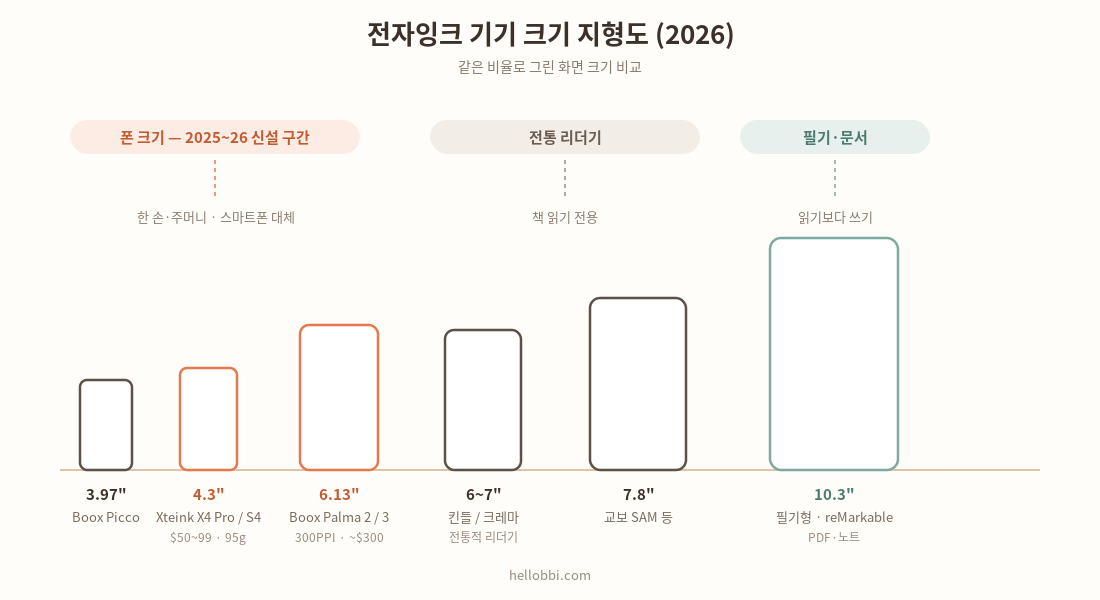
The two leftmost groups are new. Traditional e-readers are devices for reading books. This size class is closer to something that replaces or supplements your phone.
Around four inches
| Device | Screen | Notes | Price |
|---|---|---|---|
| Xteink S4 | 4.3″ | Android 11, 6.98 mm thick, 95 g, 1,400 mAh. Magnetically attaches to the back of a phone | ~$50 (China pre-order) |
| Xteink X4 Pro | 4.3″ | Adds touchscreen and adjustable front light. Battery up from 650 to 1,100 mAh | $99 |
| Boox Picco | 3.97″ | Smallest device in the Boox lineup | TBA |
The magnetic mount on the Xteink S4 explains the category. These devices aren’t asking you to carry a separate reader. They add a reading-only screen to the phone you already carry — a way to read without a backlit, notification-heavy display in your hand.
Early models shipped without touch or front light. The X4 Pro adds both, which is what moves the category from curiosity to usable. Whether four inches is comfortable for long-form reading is a separate question, and opinions divide sharply.
Around six inches
Boox Palma created this class. At 6.13 inches with 824×1648 resolution and 300 PPI, text is as sharp as a standard e-reader while the device fits one hand like a phone. The Palma 2 runs a Snapdragon 6350 with 6 GB RAM and 128 GB storage — essentially an Android device with an E Ink screen.
The Palma 3 is expected to arrive in black and white under $300, moving to a Carta 1300 panel for better contrast and shipping with Android 16. Notably it drops colour: the 2025 Palma 2 Pro used a Kaleido 3 colour screen, and the successor returns to monochrome.
Alternatives in the same class include the iReader Tango ($249.99, warm and cool front light) and the Moaan InkPalm Mini Plus 2 from the Xiaomi ecosystem, with 512 GB of storage at around $196.
Colour costs resolution
Colour E Ink layers a filter over a monochrome panel. Two consequences follow: effective resolution drops to roughly half when rendering colour, and the filter absorbs light, so the screen is dimmer overall.
For comics, magazines, and technical diagrams it earns its place. For plain text, monochrome is sharper and cheaper. The Palma 3 returning to black and white suggests the manufacturer reached the same conclusion for this size class.
If you read Korean books
This is the part that rarely appears in English reviews, and it decides the purchase.
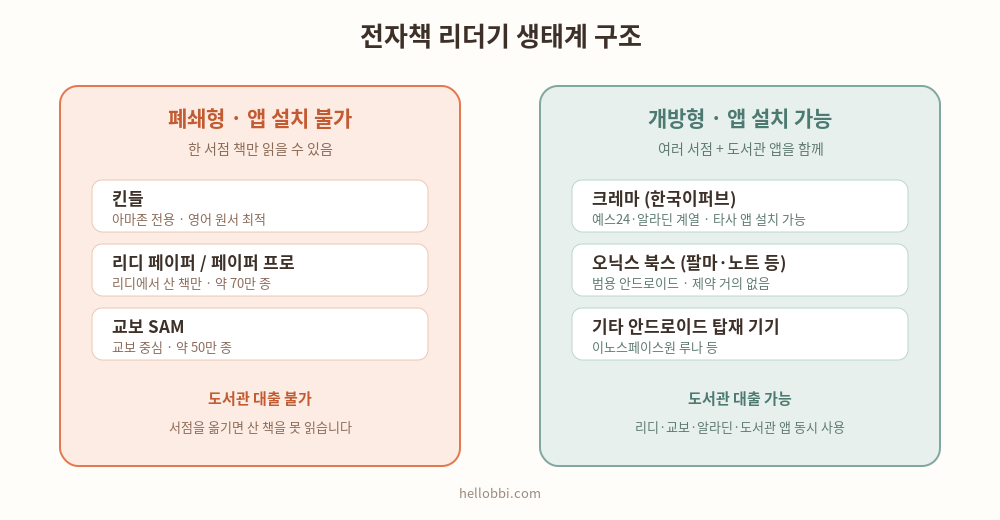
Korean e-book stores each run their own app, and titles are locked to the store you bought them from. Ridibooks holds roughly 700,000 titles, Kyobo about 500,000, and Aladin over 200,000. There is no Kindle equivalent that aggregates them.
That makes app installation the deciding factor. Ridi Paper reads only Ridi purchases. Kyobo SAM is tied to Kyobo. Kindle is tied to Amazon, which carries almost no Korean-language books. Crema devices and Onyx Boox both allow third-party apps, so a single device can run Ridi, Kyobo, and Aladin together.
Public library lending in Korea also runs through proprietary viewer apps, which means library borrowing only works on devices that can install Android apps. Most of the small devices above are Android-based, so they qualify — a practical advantage that isn’t obvious from the spec sheet.
Summary
| If you want to | Look at |
|---|---|
| Read in gaps while carrying your phone | 4-inch class (Xteink X4 Pro) |
| Read one-handed with full app freedom | Boox Palma series |
| Read Korean books across several stores | Crema or Boox |
| Borrow from libraries | Any Android-based reader |
| Read English with the best screen | Kindle |
| Annotate and write | 10-inch tablet (a different purchase) |
Decide the size class first, then check app compatibility, then compare screens. Starting with spec tables takes much longer and rarely narrows anything.
One caveat on the small devices: they are mostly sold direct from China, so warranty and service are limited outside that market. If this is your only reader, the six-inch class is the safer choice. If you already own one and want something more portable, the four-inch class is worth watching.
Leave a Reply